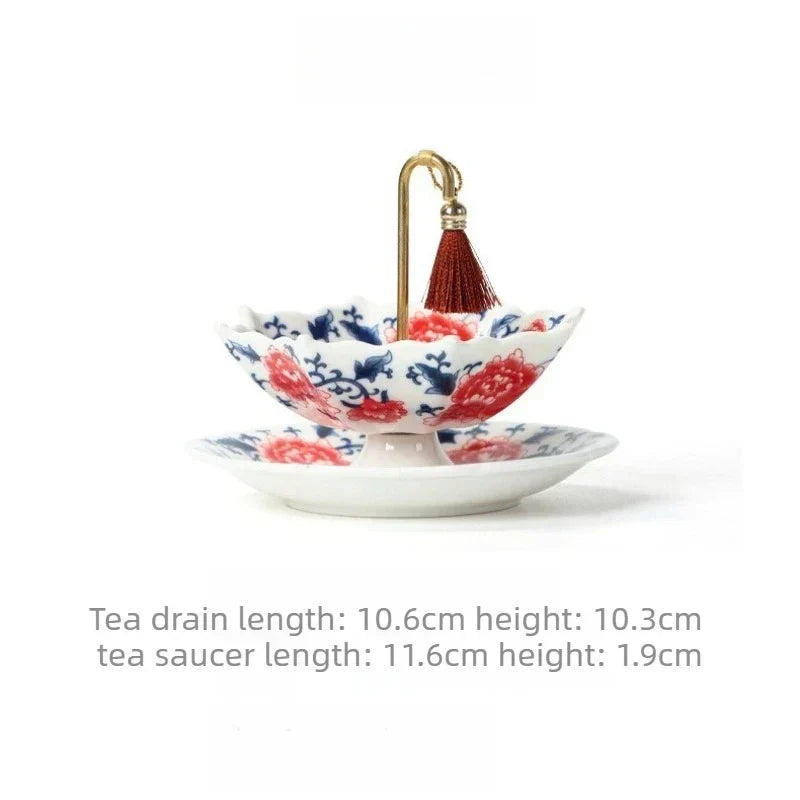
An umbrella tea strainer is a small filter shaped like an open umbrella that sits on the mouth of a fairness pitcher and catches leaf fragments as you pour tea from a gaiwan or teapot. You lift it away once the pour is done.
The canopy is ceramic or porcelain, the tip of the canopy is pierced with fine holes, and a curved handle rises from the centre like an umbrella shaft. When it is not in use it rests on its own saucer, hook up, so the wet side never touches the table.
That is the whole idea. It replaces the flat mesh basket most people picture when they hear the word strainer, and it does so with a shape that is easier to lift, easier to rinse, and much nicer to leave out on a tea tray.
The most common mistake is buying the wrong thing. Search for "umbrella tea infuser" and most results are a different tool: a small steel or silicone basket you fill with leaves and drop into a mug. An umbrella strainer never holds leaves. It only filters tea that has already been brewed. If you brew in a gaiwan or a small teapot, you want the strainer. If you brew straight in a mug, you want the infuser.
What an umbrella tea strainer actually does
A tea strainer catches the leaf fragments that escape the pot or gaiwan during a pour. Any strainer sits between the brewing vessel and the serving vessel, and it is removed once the pour is finished. Wikipedia's entry on the tea strainer describes the same job for the Western spoon-and-basket versions.
In gongfu brewing the strainer sits on the fairness pitcher, not on a cup. The pitcher, sometimes called a gong dao bei or cha hai, receives the whole infusion from the gaiwan so every guest gets tea of the same strength. Our earlier guide to the fairness pitcher explains that step in detail. The strainer's only job is to stop broken leaf from reaching the pitcher, and from there the cups.
The umbrella form changes three practical things compared with a mesh basket:
- The canopy is a solid dome with holes only near the centre. Tea runs down the inside of the dome to the perforated tip, so the flow is directed into the pitcher instead of splashing across the rim.
- The handle stands upright. You lift the strainer with dry fingers, without touching the wet canopy.
- It comes with a saucer. A used strainer drips. The saucer collects those drips, which matters on a wooden table or a dry-brew tray.
Wikipedia's article on gongfu tea lists the strainer among the standard pieces of a gongfu set, next to the gaiwan, pitcher and cups. It is not a decorative extra. Most people who brew this way use one at every session.
Umbrella tea strainer vs umbrella tea infuser
The two names get mixed up in shop listings, so here is the difference in one table.
| Umbrella tea strainer | Umbrella tea infuser | |
|---|---|---|
| Where the leaves are | In the gaiwan or teapot | Inside the infuser |
| Where it sits | On the fairness pitcher, only during the pour (5 to 10 seconds) | In the mug for the whole steep (2 to 5 minutes) |
| Typical material | Glazed ceramic or porcelain | Stainless steel mesh or silicone |
| Brewing style | Gongfu: small vessel, many short infusions | Western: one cup, one long steep |
| Comes with | A saucer to rest on between pours | Often a drip tray |
Neither is better. They solve different problems. If you are not sure which brewing style you use, our guide to choosing a gaiwan or a teapot is a good place to start.
How to use it, step by step
The routine takes a few seconds once you have done it twice.
- Place the strainer on the mouth of the fairness pitcher with the canopy facing up and the handle pointing toward you.
- Pour the finished infusion from the gaiwan into the canopy. Aim for the centre so the tea reaches the perforations quickly.
- Wait for the last drops. A gaiwan holds a lot of leaf, and the final pour carries the most fragments, so give it a moment.
- Lift the strainer by the handle and return it to its saucer.
- Serve from the pitcher.
Rinse the strainer under running water at the end of the session. Both the ceramic and porcelain umbrella strainers in our shop carry the same care line on the product page: rinse before first use, hand wash, and let it dry. Do not put a glazed ceramic strainer in a dishwasher. The perforated tip is thin, and a dishwasher rack is where thin porcelain edges chip.
Ceramic, porcelain or stainless steel
There are three material families for gongfu strainers and each one behaves differently.
| Ceramic umbrella | White porcelain umbrella | Stainless steel mesh | |
|---|---|---|---|
| Filtering | Pinholes at the tip catch larger fragments; fine dust may pass | Same principle, usually finer holes | Mesh catches almost everything, including dust |
| Flow speed | Slower, directed to one point | Slower, directed to one point | Fast, over the whole basket |
| Cleaning | Rinse; nothing to snag leaf | Rinse; nothing to snag leaf | Leaf lodges in the mesh and needs a brush |
| Heat | Stays cool enough to handle by the handle | Same | Metal handle warms up on long sessions |
| On the table | Sits on its saucer, reads as part of the set | Same, brighter in white | Functional; usually hidden after the pour |
| Weight of leaf fragments removed | Good for whole-leaf oolong, white tea and pu-erh | Same | Best for broken-leaf black tea and CTC grades |
The honest trade-off is filtration versus feel. A steel mesh strainer removes more particles. An umbrella strainer removes the pieces that would actually bother you in a cup and leaves the session looking like a tea session rather than a kitchen task. If you drink whole-leaf oolong, white tea or pu-erh cakes, an umbrella strainer is enough. If you drink a lot of fine-cut black tea, keep a mesh strainer within reach too.
What "white porcelain" means on the label
White porcelain umbrella strainers are often described as Dehua ware. Dehua is a county in Fujian province with a long record of producing thin, bright white porcelain, which Europeans later called blanc de Chine. The Dehua porcelain entry on Wikipedia covers the history in more detail than we can here. In practice the label tells you two things about a strainer: it will be whiter and thinner than stoneware, and the perforations can be finer because the body is stronger at small thicknesses.
One thing the label does not tell you is the exact size of the holes or the origin kiln. We do not print either, because we do not measure the first and cannot verify the second for every batch. If you need a stated mesh rating, the stainless steel pieces are the ones with a defined 10 x 11.5 cm basket.
Sizing: will it fit your pitcher
The ceramic Umbrella Tea Strainer in our shop measures 10.6 cm long and stands 10.3 cm tall including the handle. Its saucer is 11.6 cm long and 1.9 cm high. The canopy needs to be wider than the pitcher opening it sits on, so measure the mouth of your pitcher and compare it with that 10.6 cm figure before ordering.
We do not publish a measured width for the white porcelain version. If your pitcher has a very narrow opening, ask us for the measurement before ordering either one.
Where to buy an umbrella tea strainer
Three umbrella and umbrella-adjacent options are in stock in the tea strainers and infusers collection:
- Umbrella Tea Strainer, glazed ceramic with a brass-tone hook handle and tassel, on a matching saucer. Two patterns: blue and white with a red peony at $80.54, or plain blue and white at $63.90.
- White Porcelain Umbrella Tea Strainer, Dehua-style white porcelain with a gold handle and tip. Three variants from $22.96 to $27.96.
- Stainless Steel Leaf Tea Strainer, the mesh alternative, gold or silver finish, 10 x 11.5 cm, $45.94.
Prices are in US dollars as listed on 30 October 2026 and may change. Standard shipping is free on orders of $59 or more, and we ship worldwide.
Strainers and pitchers from this guide


Standard shipping is free on orders of $59 or more. See our tea gift guide.
Umbrella tea strainer FAQ
Where can I buy an umbrella tea strainer?
Most listings online are for steel umbrella infusers, which are a different tool. Ceramic and porcelain umbrella strainers for gongfu tea are sold by teaware shops. Ours are in the tea strainers and infusers collection: the glazed ceramic Umbrella Tea Strainer and the White Porcelain Umbrella Tea Strainer.
Does a ceramic umbrella strainer catch fine tea dust?
Not all of it. The pinholes stop whole leaves and larger broken pieces. Very fine dust from broken-leaf black tea can pass through. For whole-leaf oolong, white tea and pu-erh that is rarely noticeable in the cup.
Can I use an umbrella strainer with a teapot instead of a gaiwan?
Yes. It filters whatever you pour into it. Teapots with a built-in filter at the spout already catch most leaf, so the strainer matters most with a gaiwan, which has no filter at all.
Can it go in the dishwasher?
We do not recommend it. Hand wash with warm water and let it air dry on its saucer. The perforated tip is the thinnest part and the most likely to chip in a rack.
Do I need the saucer?
Yes, if you care about your table. A strainer still holds a few drops of tea after the pour, and the saucer catches them. On a bamboo or wooden tray that keeps water marks off the wood.
What size pitcher does it fit?
The canopy has to be wider than the pitcher opening. Our ceramic umbrella strainer is 10.6 cm long. Measure the opening of your pitcher before ordering. If the opening is close to 10 cm or wider, the canopy will not sit firmly.
If you are still assembling the set, the two guides on choosing a gaiwan or a teapot and on the fairness pitcher cover the other two pieces the strainer sits between.
Get 10% off your first order
Join our email list for new teaware, brewing guides and a 10% welcome code. Unsubscribe anytime.