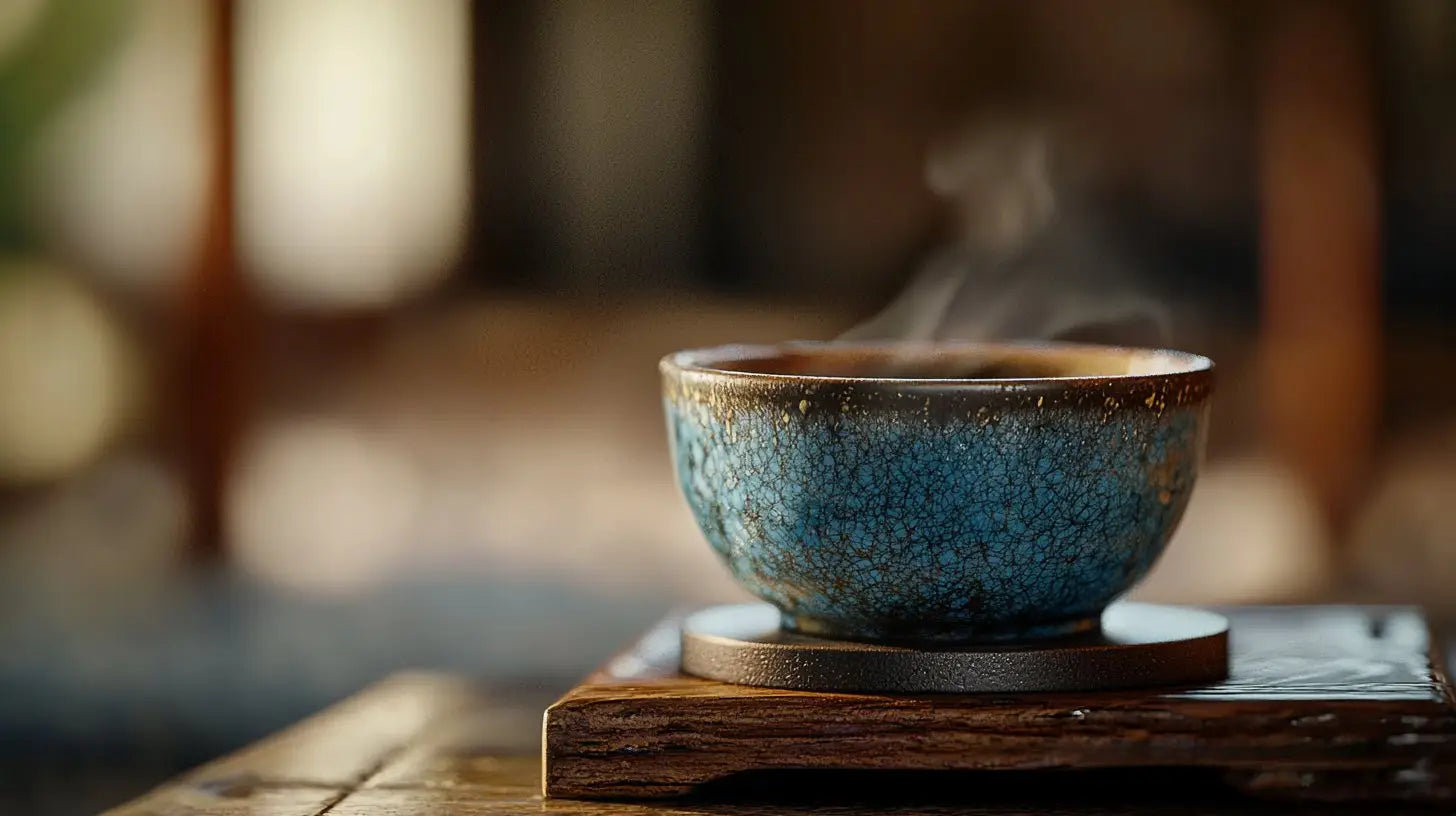
잘 맞는 경우
녹차, 백차, 향차, 비교 테이스팅처럼 깨끗하고 중립적인 맛 표현을 원하는 경우.
The Lotus Ruyi covered vessel is a Jun porcelain lidded bowl modelled as an opening lotus, made at Shenhou in Yuzhou, Henan.
Petal contours run through the bowl, the cover and the foot, so the piece reads as a single flower rather than a bowl with a lid. The supplier also photographs it holding sprouting seeds, which is one way they display it rather than a stated function of the ware.
Jun ware (钧瓷) is one of the Five Great Kilns of the Song dynasty, named alongside Ru, Guan, Ge and Ding. It is still fired at Shenhou, the kiln town in Yuzhou, Henan that has produced it for roughly a thousand years. A Jun glaze is not painted on: copper and iron oxides suspended in the glaze re-form during firing, and the colour that emerges depends on the temperature, the kiln atmosphere and where the piece happened to stand. Potters sum it up as 入窑一色,出窑万彩 — one colour goes into the kiln, ten thousand come out.
That is also why the piece you receive will not match the photographs exactly. In the maker’s own words, differences in colour and pattern between pieces are natural kiln transmutation (窑变), not a fault.
The supplier shows this piece in several glazes and gave us one page price, not a price per glaze. Tell us which glaze you want when you order, or ask us first — see “Which piece will I actually receive?” below.
| Piece | 莲花如意盏 |
|---|---|
| Material | Jun-glazed ceramic |
| Glaze | Jun kiln transmutation (窑变) |
| Kiln / studio | Wangsong Ancient Kiln (望嵩古窑) |
| Origin | Shenhou, Yuzhou, Henan, China (location of the kiln named above) |
All dimensions are the supplier’s own hand measurements and can vary by about 1 cm.
These instructions are translated from the maker’s own care sheet. Dust with a soft, dry cotton cloth, and use a soft brush for relief work and recessed areas. If you need a damp cloth, dry the piece immediately afterwards.
Keep it out of damp rooms and out of direct sunlight — the maker notes that prolonged sunlight can shift Jun glaze colour. For storage, wrap the piece in cotton and keep it in a dust box somewhere dry and ventilated. Always carry it with two hands, supporting the base. Use only a mild porcelain cleaner, never a corrosive one.
No, and it is not meant to. Jun glaze colour is created by kiln transmutation (窑变) rather than painted on, so every firing lands somewhere different. The maker states plainly that differences in colour and pattern between pieces are a natural result of the process and not a quality fault. The photographs show the piece the supplier fired; yours will be recognisably the same object in a glaze of its own.
Jun ware (钧瓷) is one of the Five Great Kilns of the Song dynasty, alongside Ru, Guan, Ge and Ding. It is defined by a thick, opalescent glaze containing copper and iron that re-forms in the kiln into blues, purples and reds. It has been fired at Shenhou in Yuzhou, Henan for roughly a thousand years, and this piece is made there.
The supplier’s source page shows several glazes. This listing is one piece at one price, and we have not been given per-glaze pricing, so we are not going to invent variant prices for it. Tell us which of the pictured glazes you want when you order, or message us first and we will confirm what is available and what it costs before you buy.
Dust with a soft dry cotton cloth and use a soft brush on relief work. If you use a damp cloth, dry the piece straight afterwards. Keep it out of damp rooms and out of direct sunlight — the maker notes prolonged sunlight can shift Jun glaze colour. Carry it with two hands, supporting the base, and store it wrapped in cotton in a dry place.
At Shenhou, Yuzhou, Henan, China. Shenhou is the kiln town in Yuzhou that Jun ware has been fired in since the Song dynasty; it is still where the kilns are. The supplier's specification sheet for this piece names the kiln (Wangsong Ancient Kiln (望嵩古窑)) rather than printing a separate place of origin.
We ship worldwide.
Free standard shipping on orders of US$69 or more. Orders below US$69 are charged US$7.90 for standard shipping.
Orders are processed in 1-3 business days. Standard shipping usually takes 8-12 business days after dispatch.
구매 전에 현재 반품 가능 조건을 확인해 주세요.
주문 관련 도움이 필요하면 상품을 보내기 전에 먼저 문의해 주세요. 가능 여부와 다음 단계를 확인하겠습니다.
구매 전 확인
Porcelain은 향이 덜 배고 깔끔한 맛 표현이 좋아 여러 차를 번갈아 마시기에 편한 소재입니다.
녹차, 백차, 향차, 비교 테이스팅처럼 깨끗하고 중립적인 맛 표현을 원하는 경우.
두께, 무게, 입술이 닿는 느낌, 유약 상태, 일상용인지 소장용인지 확인하세요.
필요하면 예열하고, 차의 향과 탕색을 선명하게 보여 주는 용도로 사용하세요.
물로 헹구고 부드럽게 닦으세요. 유약 표면에 강한 충격을 주지 마세요.
무엇인가요? Lotus Ruyi Covered Vessel — decorative vessel by Wangsong.
추천 용도: Display, collecting, and gifting — Jun porcelain art fired at Shenhou in Yuzhou, Henan.
소재: Jun-glazed ceramic
제작 방식: Jun kiln transmutation (窑变)
원산지: Shenhou, Yuzhou, Henan, 중국
가격: 부터 $998.00 · 재고 있음
배송: 주문 처리에는 1–3영업일이 걸리며 발송 후 일반 배송은 보통 8–12영업일입니다. 전 세계 일반 배송은 US$69 이상 주문 시 무료이며, US$69 미만은 US$7.90 또는 결제 화면에 표시되는 현지 통화 상당액입니다.
반품: 배송 후 14일 이내에 반품을 요청해 주세요. 사용하지 않은 새 상품만 우편 반품할 수 있으며 재입고 수수료는 0%, 교환은 불가하고 승인된 환불은 14일 이내에 처리됩니다.
도움이 되는 링크:Shop the Jun porcelain series · Jun porcelain art & collectibles

유형: Travel Teaware


당신의 카트는 현재 비어 있습니다.
Not sure where to start?
Try these collections:
The Lotus Ruyi covered vessel is a Jun porcelain lidded bowl modelled as an opening lotus, made at Shenhou in Yuzhou, Henan.
Petal contours run through the bowl, the cover and the foot, so the piece reads as a single flower rather than a bowl with a lid. The supplier also photographs it holding sprouting seeds, which is one way they display it rather than a stated function of the ware.
Jun ware (钧瓷) is one of the Five Great Kilns of the Song dynasty, named alongside Ru, Guan, Ge and Ding. It is still fired at Shenhou, the kiln town in Yuzhou, Henan that has produced it for roughly a thousand years. A Jun glaze is not painted on: copper and iron oxides suspended in the glaze re-form during firing, and the colour that emerges depends on the temperature, the kiln atmosphere and where the piece happened to stand. Potters sum it up as 入窑一色,出窑万彩 — one colour goes into the kiln, ten thousand come out.
That is also why the piece you receive will not match the photographs exactly. In the maker’s own words, differences in colour and pattern between pieces are natural kiln transmutation (窑变), not a fault.
The supplier shows this piece in several glazes and gave us one page price, not a price per glaze. Tell us which glaze you want when you order, or ask us first — see “Which piece will I actually receive?” below.
| Piece | 莲花如意盏 |
|---|---|
| Material | Jun-glazed ceramic |
| Glaze | Jun kiln transmutation (窑变) |
| Kiln / studio | Wangsong Ancient Kiln (望嵩古窑) |
| Origin | Shenhou, Yuzhou, Henan, China (location of the kiln named above) |
All dimensions are the supplier’s own hand measurements and can vary by about 1 cm.
These instructions are translated from the maker’s own care sheet. Dust with a soft, dry cotton cloth, and use a soft brush for relief work and recessed areas. If you need a damp cloth, dry the piece immediately afterwards.
Keep it out of damp rooms and out of direct sunlight — the maker notes that prolonged sunlight can shift Jun glaze colour. For storage, wrap the piece in cotton and keep it in a dust box somewhere dry and ventilated. Always carry it with two hands, supporting the base. Use only a mild porcelain cleaner, never a corrosive one.
No, and it is not meant to. Jun glaze colour is created by kiln transmutation (窑变) rather than painted on, so every firing lands somewhere different. The maker states plainly that differences in colour and pattern between pieces are a natural result of the process and not a quality fault. The photographs show the piece the supplier fired; yours will be recognisably the same object in a glaze of its own.
Jun ware (钧瓷) is one of the Five Great Kilns of the Song dynasty, alongside Ru, Guan, Ge and Ding. It is defined by a thick, opalescent glaze containing copper and iron that re-forms in the kiln into blues, purples and reds. It has been fired at Shenhou in Yuzhou, Henan for roughly a thousand years, and this piece is made there.
The supplier’s source page shows several glazes. This listing is one piece at one price, and we have not been given per-glaze pricing, so we are not going to invent variant prices for it. Tell us which of the pictured glazes you want when you order, or message us first and we will confirm what is available and what it costs before you buy.
Dust with a soft dry cotton cloth and use a soft brush on relief work. If you use a damp cloth, dry the piece straight afterwards. Keep it out of damp rooms and out of direct sunlight — the maker notes prolonged sunlight can shift Jun glaze colour. Carry it with two hands, supporting the base, and store it wrapped in cotton in a dry place.
At Shenhou, Yuzhou, Henan, China. Shenhou is the kiln town in Yuzhou that Jun ware has been fired in since the Song dynasty; it is still where the kilns are. The supplier's specification sheet for this piece names the kiln (Wangsong Ancient Kiln (望嵩古窑)) rather than printing a separate place of origin.