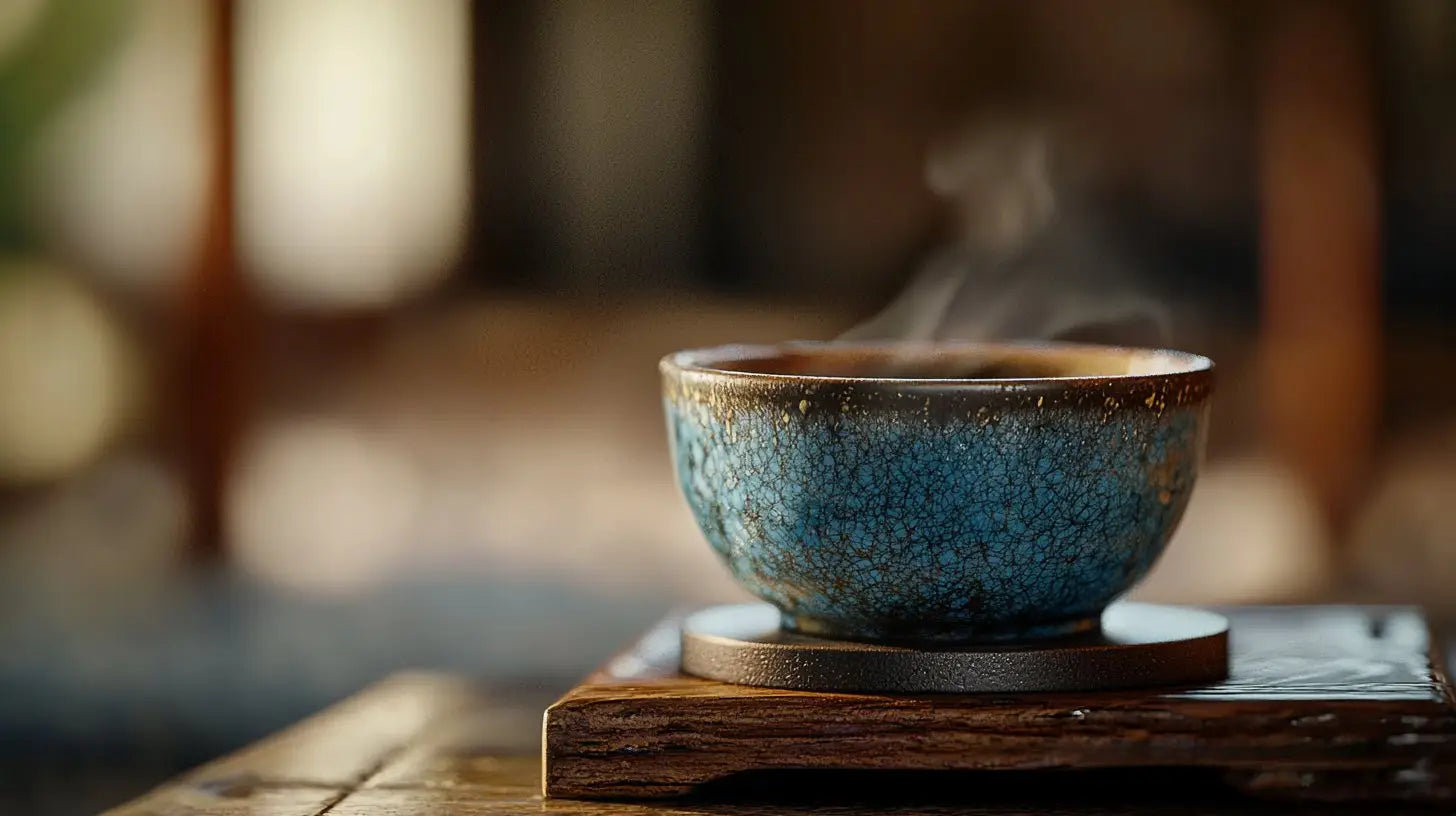
Jun Porcelain – Kiln Transmutation from Shenhou
Jun porcelain (钧瓷, also written Jun ware or Junyao) is one of the Five Great Kilns of the Song dynasty, named alongside Ru, Guan, Ge and Ding. It is still fired at Shenhou, the kiln town in Yuzhou, Henan that has produced it for roughly a thousand years.
What separates Jun from the other porcelains on a tea table is that its colour is not decided by the potter. Copper and iron oxides suspended in a thick glaze re-form during the firing, and the blues, purples and reds that emerge depend on the temperature, the kiln atmosphere, and where in the kiln the piece happened to stand. Potters sum it up in one line: 入窑一色,出窑万彩 — one colour goes into the kiln, ten thousand come out.

What kiln transmutation actually means
Kiln transmutation (窑变, yaobian) is the reason no two Jun pieces match, including two pieces pulled from the same firing. The glaze is a suspension, not a paint layer. Under heat it separates, moves and re-forms, and copper in particular shifts across a wide range of reds and purples depending on how much oxygen is in the kiln at each moment. The potter controls the clay body, the form, the glaze recipe and the firing schedule. The final colour is an outcome, not a specification.
That has a consequence worth stating plainly before you buy: the piece you receive will not match the photographs exactly. In the maker's own words, differences in colour and pattern between pieces are natural kiln transmutation, not a fault. The photographs show the piece that particular firing produced. Yours will be recognisably the same object in a glaze of its own.
This is also why Jun is collected rather than merely bought. A Jun piece cannot be reordered. If a specific one appeals to you, it is the only one of it.
Jun compared with the other kilns we carry
| Kiln | What defines it | Where it sits on the tea table |
|---|---|---|
| Jun (钧瓷) | Thick opalescent glaze carrying copper and iron that re-forms in the kiln | Statement pieces and sculpture; teaware where you want the glaze to be the subject |
| Ru (汝窑) | Pale blue-green glaze with a fine crackle that darkens with use | Cups and gaiwan for people who want a surface that changes over years |
| Jian Zhan / Tenmoku (建盏) | Iron-saturated glaze fired at Jianyang into hare's fur and oil-spot patterns | Tea cups, particularly for darker teas |
| Dehua white porcelain (德化白瓷) | White porcelain body with no colour interference | Neutral tasting: green, white and jasmine tea |
| Yixing zisha (宜兴紫砂) | Unglazed purple clay, porous, usually dedicated to one tea family | Pu-erh and oolong brewing |
How a Jun piece is made
The form is thrown or moulded, dried, and bisque fired. The Jun glaze is then applied thickly — noticeably thicker than a porcelain glaze meant to stay transparent — and the piece is fired again. During that second firing the glaze softens, flows, and the metal oxides in it re-form. Where the glaze pools in a recess it reads one colour; where it thins over a raised edge it reads another. On a piece with relief work, the modelling and the colour end up describing the same shape by two different means.

Losses are part of the economics. A firing that moves the glaze also moves it in ways nobody wanted, and pieces come out of the kiln that will not be sold. That is built into what a finished Jun piece costs.
How to judge a Jun piece
- Read the glaze at the edges, not the middle. Rims, handles and raised relief are where the glaze thins and where a firing either succeeded or did not. A flat, even colour across a whole piece usually means less transmutation, not more skill.
- Look for depth rather than brightness. A good Jun glaze looks like it has layers under the surface. A thin, poster-bright colour is a different effect.
- Check the form independently of the colour. Transmutation is spectacular enough to distract from a mediocre shape. Cover the colour mentally and ask whether you would still want the object.
- Accept the variation, then choose within it. Since no two are alike, the honest question is not "is this the right colour" but "is this one I want to live with".
- Match the piece to the use. A sculpture is a display object. A cup or a teapot is going to get hot water in it daily, and the form matters more than the glaze there.

Care
These notes are translated from the maker's own care sheet. Dust with a soft, dry cotton cloth, and use a soft brush for relief work and recessed areas. If you need a damp cloth, dry the piece immediately afterwards. Use only a mild porcelain cleaner, never a corrosive one.
Keep Jun out of damp rooms and out of direct sunlight — the maker notes that prolonged sunlight can shift Jun glaze colour. For storage, wrap the piece in cotton and keep it in a dust box somewhere dry and ventilated. Always carry it with two hands, supporting the base.
On food safety: the pieces we carry come from Wangsong Ancient Kiln with no supplier testing for food contact, dishwasher, microwave or thermal shock, so we do not publish claims we cannot stand behind. Hand wash the drinking vessels, do not put any of it in a dishwasher or microwave, and treat the sculptural pieces as display objects.
Frequently asked questions
What is Jun porcelain?
Jun ware (钧瓷) is one of the Five Great Kilns of the Song dynasty, alongside Ru, Guan, Ge and Ding. It is defined by a thick, opalescent glaze containing copper and iron that re-forms in the kiln into blues, purples and reds. It has been fired at Shenhou in Yuzhou, Henan for roughly a thousand years.
Why doesn't my piece match the photographs?
Because Jun colour is produced by kiln transmutation rather than painted on, so every firing lands somewhere different. The maker states plainly that differences in colour and pattern between pieces are a natural result of the process and not a quality fault.
Where is Shenhou?
Shenhou (神垕) is a kiln town in Yuzhou, Henan province, China. It is where Jun ware has been fired since the Song dynasty, and it is still where the working kilns are. Every Jun piece we carry is made there.
Can I drink tea from Jun porcelain?
The Jun teaware we carry is made as teaware and is used that way in China. That said, our supplier provides no food-contact, dishwasher, microwave or thermal-shock testing for these pieces, so we make no safety claim of our own. Hand wash only, and keep it away from dishwashers and microwaves.
Is Jun porcelain still made today?
Yes. Production at Shenhou is continuous and contemporary; these are not antiques. The pieces we carry were made by Wangsong Ancient Kiln (望嵩古窑) at Shenhou using the same transmutation glaze process.
Why is Jun more expensive than other porcelain?
Two reasons. The glaze is applied thickly and fired a second time, which is slower and more material-intensive than a standard glaze firing. And the same instability that produces the colour also produces failures — pieces come out of the kiln unsellable, and the ones that succeed carry that cost.
Explore
Browse the full series at Jun Porcelain from Shenhou, or go straight to Jun Porcelain Art & Collectibles for the sculptures and vases, and Jun Porcelain Teaware for the pots and cups. Everything from this maker sits together under Wangsong Ancient Kiln Porcelain.
Reading on the other kilns: Ru kiln crackle glaze · The art of making Jian Zhan · Jianshui Zitao · Yixing zisha teapots