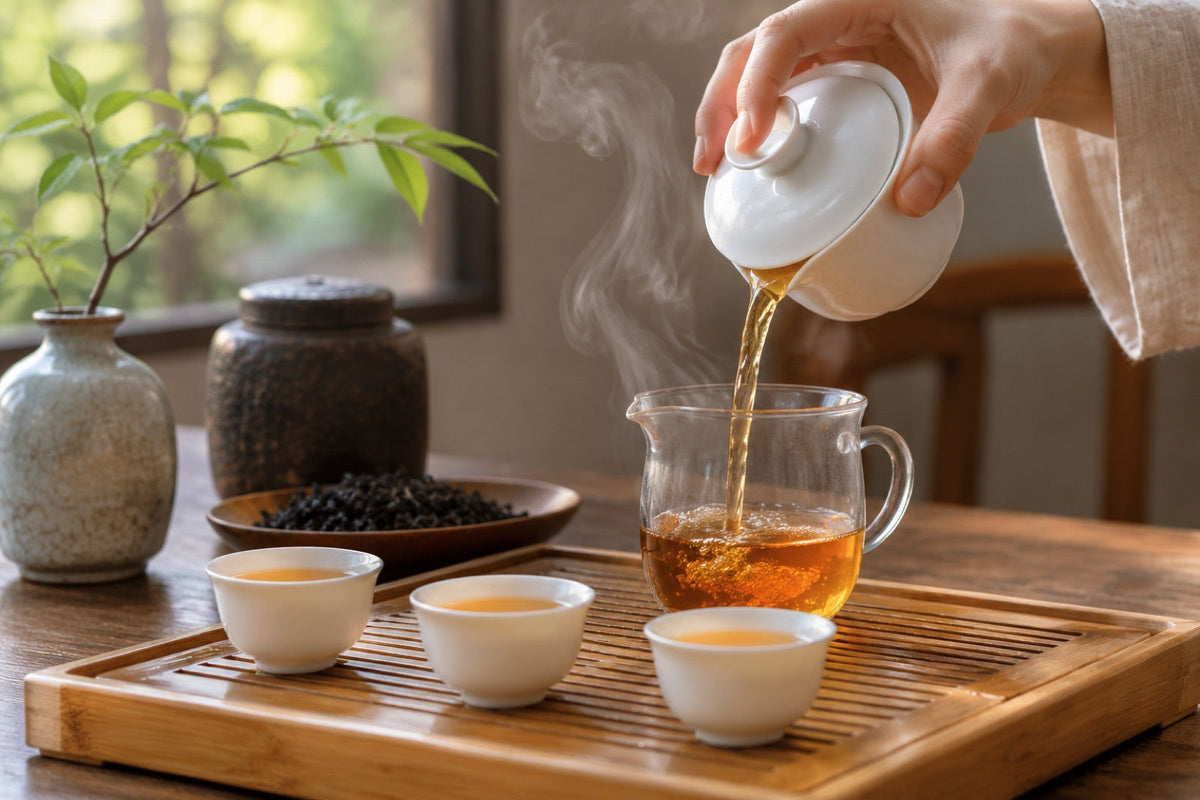
Chinese tea cups are small because gongfu tea is brewed strong and fast in a small pot, then served in many short rounds. A 100 ml gaiwan pours about 30 ml each for three people, and the next infusion is ready in under a minute. The cup holds one pour, so every pour is hot, fresh and the same strength.
Here is the mistake most people make with their first gongfu set: they use the tiny cup like a mug and fill it, then wait. By the time they finish, the second infusion has sat in the pot for three minutes and turned bitter. The small cup is a timer. Drink it, and the pot is ready again.

This is not a modern design trend
The poet and food writer Yuan Mei visited the Wuyi Mountains in the autumn of 1786 and wrote about the monks who served him tea there. In his food book Suiyuan Shidan, he describes cups "as small as a walnut" and teapots "as small as a citron." He had disliked Wuyi tea as too strong and bitter. Served that way, he wrote, he could not bear to swallow it quickly: he smelled it first, then tasted, then let it linger. (Source: the original Chinese text on Wikisource.)
That is still the logic today. Gongfu tea grew up in Fujian and the Chaoshan area of eastern Guangdong. Brewing vessels there usually hold 60 to 200 ml, and the matching cups usually hold 25 to 100 ml, traditionally three of them (Wikipedia: Gongfu tea). If you want the full method around the cups, our gongfu tea guide walks through it step by step.
6 reasons the cups stay small
1. The pot is small, so the pour is small
Gongfu brewing uses a lot of leaf in a little water, about 5 g of tea per 100 ml as a starting point. The leaves soak up part of the water, so a 100 ml gaiwan gives you roughly 80 to 90 ml of tea per infusion. Split three ways, that is about 30 ml each. A 300 ml mug would need the whole pot four times over.
2. You drink in rounds, not in one long cup
Good oolong, pu-erh and black tea can be infused many times, with early steeps of 10 to 20 seconds that get longer as the leaves open. Each round tastes a little different. A small cup means you taste every round instead of one mixed, cooling mug. Over a session of eight or nine infusions, three people each drink a normal amount of tea. It just arrives in pieces.
3. A small pour cools to drinkable fast
Gongfu water is hot, often just off the boil for oolong and pu-erh. A thin layer of tea in a small cup has a lot of surface for its volume, so it loses heat quickly. You can lift it, smell it and sip it while the next infusion steeps. In a big mug the same tea stays too hot to drink for minutes, then goes lukewarm while you are still on the first half.
4. The strength stays even
Tea keeps getting stronger as long as it sits on the leaves. That is why gongfu tea is poured out completely each round, usually into a pitcher, then shared. Decanting into a pitcher first means every guest gets tea of the same strength. Small cups make this easy: one pitcher fills three or four cups exactly, and nothing is left sitting. Our guide to the fairness pitcher explains how the two pieces work together.
5. Aroma is the point, and small cups hold it close
Yuan Mei smelled before he tasted, and gongfu drinkers still do. A small cup brings your nose right to the surface of the tea. Many people also smell the empty cup after the last sip, because the aroma clings to the warm porcelain. Thin white porcelain is popular for this reason, and because it shows the true color of the tea.
6. Serving is part of the hospitality
A small cup gets emptied often, so the host refills it often. In Chaoshan, the host invites guests to drink by saying one word, "eat," and the guests answer with the same word. Each refill is a small moment of attention. A mug filled once and handed over does not work that way.
Why do Chinese tea cups have no handles?
Because they do not need them. A 30 to 50 ml cup is filled about two thirds full, and the rim stays cooler than the tea. The usual grip is thumb and index finger on the rim, with the middle finger supporting the foot. If a cup is too hot to hold that way, the tea is also too hot to sip, so you wait a few seconds. Larger handle-free cups are a different story: that is where double walls or a thicker clay body help.
Which cup size should you choose?
There is no single correct size. Match the cup to your brewer and how many people drink with you.
| Cup size | Best for | Pairs with |
|---|---|---|
| 20–30 ml | Strong, aromatic tea; Chaoshan-style rounds; groups of 4–6 | 90–135 ml gaiwan or teapot |
| 40–60 ml | Everyday gongfu for 2–3 people; the easiest size to start with | 120–180 ml gaiwan or teapot |
| 80–100 ml | Drinking alone, or relaxed sessions with black tea and ripe pu-erh | 150–200 ml brewer, one cup per pour |
| 150 ml and up | Grandpa-style tea or casual daily drinking, not gongfu rounds | Leaves straight in the cup or a mug infuser |
A quick check: your brewer's pour should fill all your cups once with a little left over. If you brew in a 120 ml gaiwan for two people, two 50 ml cups are right. Six 25 ml cups also work, but you will be pouring a lot.
Are small cups a whole-China thing?
No. Tiny cups belong to gongfu tea, which is strongest in Fujian, Chaoshan and Taiwan. Plenty of people in China drink green tea from a tall glass with the leaves floating in it, or carry a large lidded mug to work and top it up all day. Both are normal. The small cup is the tool for one specific way of brewing, not a rule for all Chinese tea.
What to buy (and what to skip)
- Buy 2–4 cups of 40–60 ml first. This size forgives a heavy pour and suits most teas. The Echo of Stillness Yixing cups are 50 ml each in sets of 4 or 6. Unglazed clay picks up aroma over time, so keep clay cups for one type of tea and rinse them without soap.
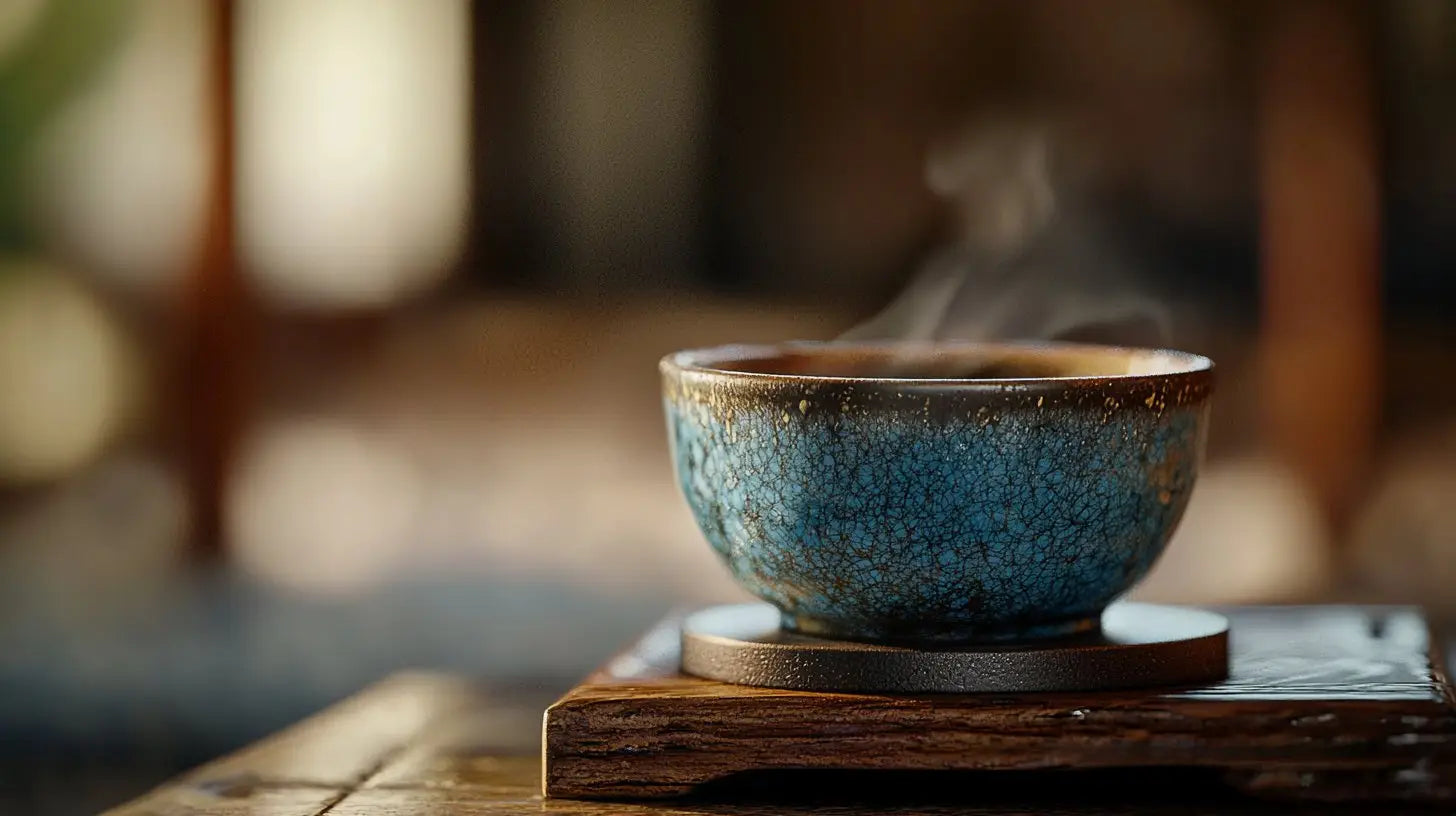
- Buy one cup you love looking into. A dark tenmoku glaze makes the tea's color glow. The Golden Peacock Jian Zhan cup is kiln-fired in Jianyang, so no two glazes match exactly. It is also an easy gift.
- Buy a pitcher if you drink with anyone else. It is what keeps the cups even. A glass fairness cup lets you watch the color while you pour.
- Skip aroma cups at the start. The tall sniffing cup is optional and mostly used with Taiwanese high-mountain oolong. Smelling your empty tasting cup does the same job.
- Skip a six-cup set if you drink alone. One or two cups and a small gaiwan are enough. If you share tea or travel with friends, the white porcelain travel set pairs a 135 ml gaiwan with six 25 ml cups, which is the traditional ratio.
Wondering if an artisan cup is worth the price over factory porcelain? We compared them in this daily use guide. If you like tenmoku, see whether a full set or separate cups makes more sense.
Small cups and pieces from this guide


Standard shipping is free on orders of $59 or more. See our tea gift guide.
FAQ
Why do Chinese drink tea in small cups?
Because gongfu tea is brewed strong in a small pot and served in many short rounds. Each pour is small, so the cup is small. You end up drinking a normal amount of tea, spread over several infusions that each taste a little different.
How big is a gongfu tea cup?
Most gongfu cups hold 25 to 100 ml. For beginners, 40 to 60 ml is the easiest size. Cups of 20 to 30 ml are typical for strong Chaoshan-style tea served to a group.
Why are Japanese and other Asian tea cups small too?
The reasons overlap: high-quality leaf, short infusions and several rounds. Japanese sencha, for example, is often brewed in a small kyusu and poured into small cups. The exact sizes and customs differ by country.
How many cups of tea do you drink in one gongfu session?
It depends on the leaf and the group. With 5 g of oolong in a 100 ml gaiwan, eight or nine infusions shared by three people works out to roughly 250 ml each, close to one normal mug, but in rounds.
Can I use a small tea cup for coffee or Western tea?
You can, but you will be refilling constantly. Western-style tea uses less leaf, more water and longer steeps, so it suits a mug. Small cups make sense when the brewer is also small.
Do small tea cups make good gifts?
Yes, especially a single striking cup or a pair. They are easy to wrap, useful for any tea and do not require the person to own a full set. For US Christmas delivery, order by December 1.
Ready to set up your table? Browse our small tea cups, or read Gaiwan vs Teapot to choose the brewer that goes with them.
Get 10% off your first order
Join our email list for new teaware, brewing guides and a 10% welcome code. Unsubscribe anytime.