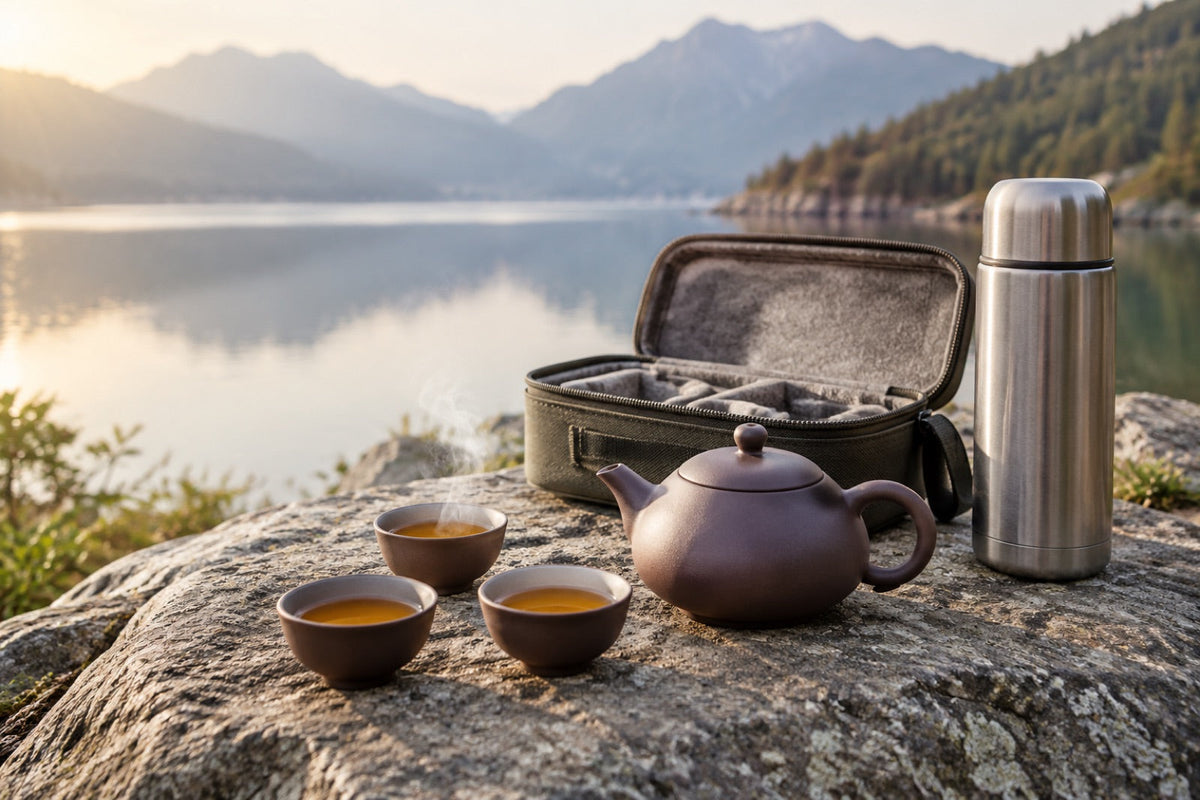
Use a Chinese travel tea set the same way you would use a small Gongfu setup: more leaf than you think, short steeps, and pour every drop out of the pot each round. In a 250 ml travel teapot that means about 5 to 7 grams of leaf, water close to boiling for oolong, black tea and pu-erh, and first steeps of 15 to 30 seconds. Then lengthen each steep a little.
Most people get the brewing right within two sessions. What goes wrong is everything around it. The water is too cool by the time they open the thermos. Leaves sit in the pot between rounds and the third cup turns bitter. Or the set goes back into its case damp and smells like an old sponge a week later. This guide covers those parts, step by step.

What is in a travel tea set, and what each piece does
Travel sets vary, but most Chinese-style kits are a shrunk-down Gongfu table that fits in a zip case. Here is what you usually get and how each piece behaves on the road.
| Piece | Job | On-the-road tip |
|---|---|---|
| Teapot or gaiwan | Brews the tea | Hold the lid down with a fingertip when pouring. Travel pots are light and lids slide. |
| Infuser insert | Holds the leaves so you can lift them out | Lift it out or tilt the pot fully at the end of each steep. Leaves left in water keep brewing. |
| Small cups (usually 40 to 60 ml) | Serving | Small cups cool fast, which is the point. You taste more when the tea is not scalding. |
| Carry case | Protects everything | Never close it on wet pieces. |
What a travel set usually leaves out: a fairness pitcher, a tray, and the tea tools. You can live without all three. The pouring trick in step 6 replaces the pitcher.
Step 1: Sort out hot water first
Hot water decides how good the session will be, so plan it before you pack the tea.
- Hotel room: an electric kettle is ideal. If the room only has a pod coffee maker, run one cycle with plain water and throw it away first. Otherwise your oolong tastes faintly of last guest's dark roast.
- Office: the hot tap on most water dispensers is not boiling. That is fine for white and green tea, and a bit weak for rolled oolong or pu-erh. Use more leaf and longer steeps to make up for it.
- Trail or road trip: a good vacuum flask holds heat well, but not forever. Zojirushi rates its 18 oz stainless bottles at about 153 to 160°F (67 to 71°C) six hours after being filled with 203°F water (manufacturer spec). That is right for white tea, a little low for oolong. Fill the flask as late as you can, and drink the oolong first.
Step 2: Warm the pot
Pour a splash of hot water into the empty pot, put the lid on, swirl, and pour it over the cups. It takes ten seconds. A cold clay pot steals heat from the first steep, and on a cold morning outdoors the difference is easy to taste.
Step 3: Use more leaf than a mug would need
This is the part that feels wrong to mug drinkers. Gongfu-style brewing uses a lot of leaf and very little time. A practical start is about 5 grams per 100 ml of water you plan to pour. For a 250 ml travel pot used two-thirds full, that is 7 to 8 grams. Rolled oolong will roughly fill the infuser once it opens, so do not pack it to the top dry.
No scale on the road? Pre-portion your tea at home into small paper envelopes or zip bags, one per session. It also makes airport screening simpler, since dry tea is allowed in both carry-on and checked bags (TSA food rules). Brewed tea in a bottle counts as a liquid, so empty the flask before security and refill it after.
Step 4: Rinse (for some teas)
For rolled oolong and pu-erh, cover the leaves with hot water and pour it straight out after 3 to 5 seconds. This wakes the leaves up and the next steep opens faster. Skip the rinse for green tea, white tea and flowering tea. You would be throwing away the best cup.
Step 5: Steep short, then go longer
| Tea | Water | First steep | Then add | Good for |
|---|---|---|---|---|
| Rolled oolong | 195 to 205°F (90 to 96°C) | 20 to 30 s | +5 to 10 s each | Hotel and office. Compact, forgiving, 5 or more steeps. |
| Ripe pu-erh | Near boiling | 10 to 15 s | +5 s each | Cold mornings, long sessions |
| White tea | 175 to 185°F (80 to 85°C) | 30 to 40 s | +10 s each | Thermos water |
| Black tea | 195 to 205°F | 15 to 20 s | +5 s each | Anyone used to breakfast tea |
| Flowering tea | 185 to 195°F | 2 to 3 min | Top up as you drink | Sharing, gifts (best in a clear glass) |
If a cup tastes thin, add time on the next round. If it tastes harsh or drying, shorten the next steep or let the water cool for a minute. For oolong in more detail, see the oolong brewing guide.
Step 6: Pour everything out, in passes
Here is the mistake that makes travel tea bitter. A travel set has no fairness pitcher, so people pour one cup, chat, pour another later. Meanwhile the leaves keep steeping. By the third cup the tea is twice as strong as the first.
The fix takes no extra gear. Pour each round all at once, moving along the row of cups in passes: a little into each cup from left to right, then back from right to left until the pot is empty. Every cup gets a mix of the light first pour and the strong last pour. Then lift out the infuser, or leave the lid off so the leaves stop cooking.
Watch the numbers on your set too. A pot that holds 250 ml with the infuser in cannot fill six 50 ml cups. Five full cups is the real limit, and less once the leaves expand. For two people, pour two or three cups each per round and brew more rounds. That is the whole idea of Gongfu tea anyway.
Step 7: Clean and dry before you pack

Empty the spent leaves into a bag or bin. On a trail, pack them out. Wet tea leaves are not litter that "just disappears". Rinse every piece with hot water. Skip the soap on unglazed clay, because clay absorbs it and the next cup tastes of it. Our guide to caring for a Yixing teapot explains why.
Then the step everybody skips: dry everything before it goes back in the case. Set the lid beside the pot, cups upside down, on a towel or a hotel washcloth for 20 to 30 minutes. If you have to leave before that, wrap the pieces in a dry cloth and open the case again as soon as you arrive. A closed case traps moisture, and that is where the musty smell comes from.
Which teas travel best
- Oolong: the easiest choice. Rolled oolong packs smallest and survives being knocked around. Long twisted-leaf oolong such as Duck Shit Aroma Dancong takes more room in the bag, but it gives five or more fragrant steeps from one portion and makes a hotel room smell like a tea house.
- Ripe pu-erh: very forgiving. It is hard to make it bitter, even with slightly cool water.
- White tea: the best match for thermos water because it likes lower temperatures.
- Flowering tea: one bloom per session, nothing to measure, and it looks great. But in an opaque clay pot nobody sees it open. Brew it in a clear glass, and use the clay pot for oolong. Here is how to brew flowering tea.
What to buy, and what to skip
You do not need a full tea table to drink good tea away from home. You do not need a tray, a six-piece tool set, or a scale. Here is what actually earns its place in a bag:
- A travel set with a fitted case and an infuser. The infuser makes "pour everything out" easy, and the case keeps the pot and cups from chipping each other. Our best-selling Dragon & Phoenix Zisha Travel Tea Set packs one 250 ml teapot (300 ml without the infuser), six 50 ml cups and an infuser into a case about 11 x 14 cm. Its dragon and phoenix decoration changes color as hot water warms the clay, which gets a reaction at every office desk.
- A vacuum flask if you will be away from a kettle.
- A small cotton cloth for drying and for wiping up the inevitable splash.
- Pre-portioned tea. If you are buying for someone else, the Traveler's Tea Gift Set pairs the travel set with a box of flowering tea blooms, so they can brew on day one.
If you mostly drink tea at one desk and rarely travel, a travel set is still a reasonable first set. It is small and cheap to get started with. For a setup that stays at home, see our minimal Gongfu setup for one person or browse full Gongfu tea sets.
Pack these for your next trip


Standard shipping is free on orders of $59 or more. See our tea gift guide.
FAQ
Can I bring a travel tea set on a plane?
Yes. Pack it in your carry-on so the ceramic is not thrown around in the hold. Dry loose tea is allowed in carry-on bags under TSA rules. Brewed tea follows the liquid limits, so empty your flask before security.
Is a travel tea set good for one person?
Yes. Fill the pot about halfway, use 5 to 6 grams of leaf, and pour into one or two cups. You get more rounds and every one is fresh.
How much tea do I put in a travel teapot?
Start at about 5 grams per 100 ml of water you pour. For a 250 ml pot used two-thirds full, that is 7 to 8 grams. Adjust by taste on the next session.
Can I use tea bags in a travel tea set?
You can, but you lose most of what a small pot is good at. Cut-leaf tea in bags brews fast and turns bitter in short Gongfu steeps. Whole-leaf tea is the better match.
Can I use water from a hotel coffee maker?
Yes. Run one cycle of plain water first to flush out coffee flavor. Coffee makers often deliver water below boiling, so use a little more leaf for oolong and pu-erh.
Why does my travel teapot smell musty?
It was packed damp. Rinse it with hot water, let every piece air-dry fully with the lid off, and leave the case open for a day. From then on, dry the set before you close the case.
Planning a gift? Our tea gift guide sorts sets and teas by budget. Standard shipping is free on orders of $59 or more.
Get 10% off your first order
Join our email list for new teaware, brewing guides and a 10% welcome code. Unsubscribe anytime.