Le guide ultime du service à thé chinois : du Jian Zhan au Yixing
Dans la culture chinoise du thé, le récipient est aussi important que la feuille. Le bon service à thé ne contient pas seulement le thé : il rehausse la saveur, retient la chaleur et vous connecte à des siècles d'art céramique. Ce guide complet couvre tous les principaux types de service à thé chinois, pourquoi chacun est important et comment choisir.
1. Jian Zhan Tenmoku Tasses à thé (建盏)
Origine: Jianyang, province du Fujian
Ère: Dynastie Song (960-1279 après JC), relancée dans les années 1980
Matériel: Argile riche en fer unique à la région de Jianyang
Cuisson: 1300°C+ dans un four à atmosphère réductrice
Ce qui rend Jian Zhan spécial
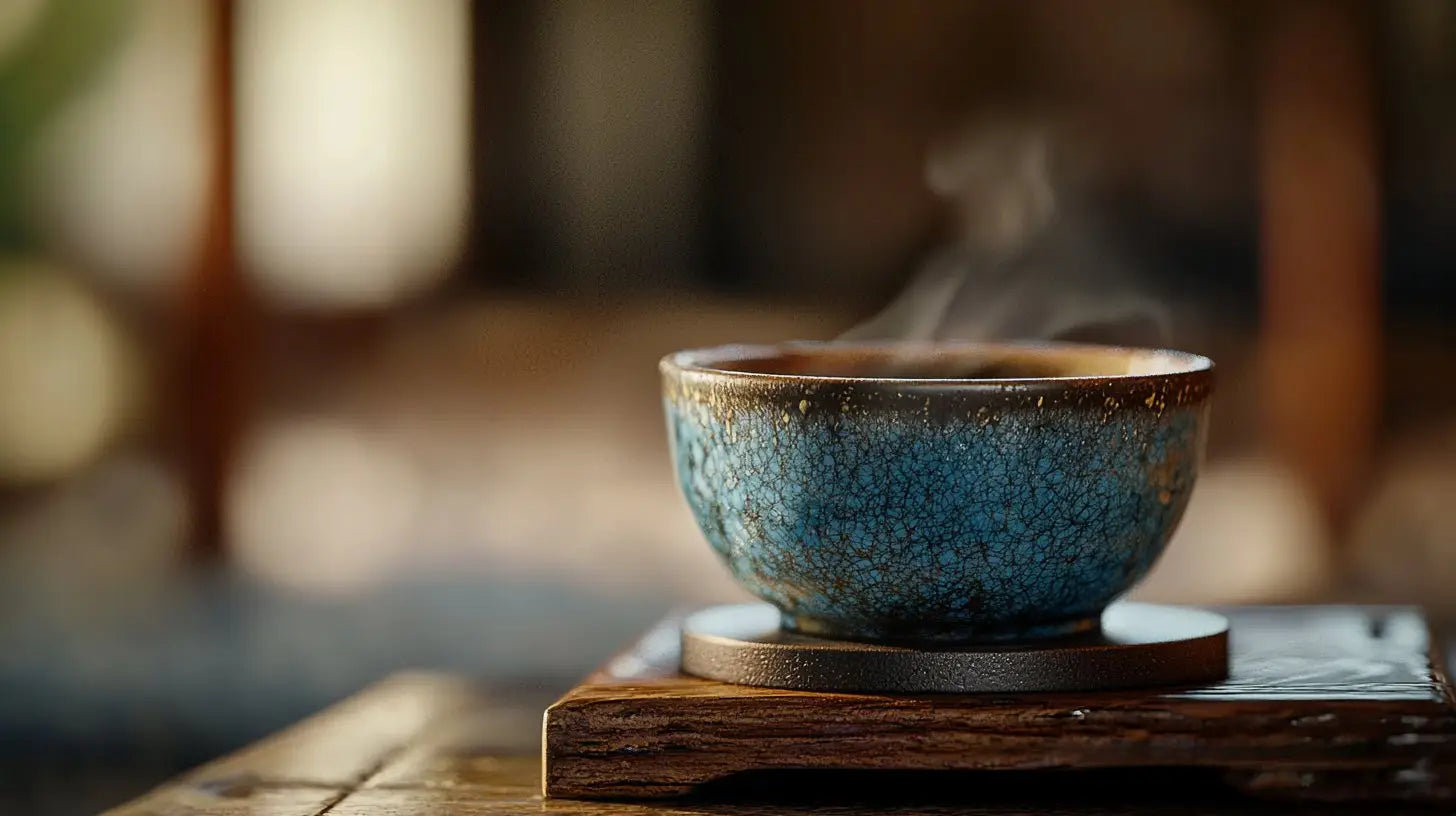
Jian Zhan (建盏) sont les bols à thé originaux Tenmoku, nés des concours de thé impériaux de la dynastie Song. L'émail riche en fer réagit de manière imprévisible à la chaleur extrême du four, produisant des motifs cristallins entièrement uniques sur chaque tasse. Deux tasses du même four, cuites côte à côte, auront un aspect complètement différent. Il s'agit d'un art créé par la collaboration entre le potier et le feu.
Types de glaçage
- Tache de pétrole (油滴) : Gouttelettes d'argent ou d'or dispersées sur la glaçure. Créé par des cristaux de fer remontant à la surface lors de la cuisson.
- Fourrure de lièvre (兔毫) : De fines stries ressemblant à de la fourrure rayonnent depuis le bord. Le modèle Jian Zhan le plus classique.
- Arc-en-ciel Tenmoku / Yaobian (曜变) : Taches irisées de couleur arc-en-ciel qui changent selon l'angle de la lumière. Le plus rare : seuls 3 bols yaobiens intacts de l’ère Song survivent dans le monde (tous dans des musées japonais).
- Plume de perdrix (鹧鸪斑) : Motif tacheté ressemblant à des plumes de poitrine de perdrix.
- Rouge kaki (柿红) : Brun rougeâtre foncé dû à l'oxydation lors de la cuisson.
Pourquoi Jian Zhan améliore le thé
Le corps d'argile riche en fer libère des traces d'ions Fe²⁺ qui peuvent adoucir l'eau et réduire l'astringence. Les parois épaisses retiennent la chaleur plus longtemps. De nombreux connaisseurs de thé signalent une tasse nettement plus douce et plus sucrée de Jian Zhan par rapport à la porcelaine standard.
Soins
Laver à la main avec de l'eau uniquement. Pas de savon, pas de lave-vaisselle, pas de micro-ondes. La tasse développe un éclat subtil (bao jiang 包浆) avec l'utilisation du thé au fil du temps – cette patine est souhaitée et non endommagée.
Gamme de prix : $29–$89
Idéal pour : Tous les thés, notamment oolong et Pu-erh
Apprendre encore plus: Jian Zhan L'héritage de la dynastie Song | Tache d'huile et Tenmoku glaçures
Comparez les tasses à thé Jian Zhan →
2. Yixing Théières en argile violette (宜兴紫砂壶)
Origine: Yixing, province du Jiangsu
Tradition: Plus de 500 ans, origines de la dynastie Ming
Matériel: Zisha (sable violet) — une argile en grès rare trouvée uniquement dans la région des montagnes Huanglong de Yixing
Pourquoi Yixing est considérée comme la meilleure théière
Les théières Yixing zisha sont largement considérées comme les meilleurs récipients pour préparer le thé. Quatre propriétés les distinguent :
- Structure à double pores : La micro-respiration à travers les parois d'argile maintient le thé à une température optimale
- Absorption des saveurs : Le zisha non glacé absorbe les huiles de thé à chaque séance, créant ainsi une « mémoire de thé »
- Rétention de chaleur : Supérieur à la porcelaine ou au verre — idéal pour les thés nécessitant une chaleur élevée et soutenue
- Aucun glaçage n'est nécessaire : Naturellement assez dense pour retenir l'eau sans vitrage
Types d'argile
| Argile | Couleur | Personnage | Idéal pour |
|---|---|---|---|
| Zini (紫泥) | Brun-violet | Riche, neutre, polyvalent | Pu-erh, oolong, thé noir |
| Zhuni (朱泥) | Rouge vermillon | Parois minces, chaleur élevée | Oolong léger, thé vert |
| Duanni (段 泥) | Jaune-vert | Léger, plus poreux | Thé vert, thé blanc |
| Hongni (红泥) | Rouge | Corps moyen | Thé noir, oolong |
La règle « Une théière, un thé »
Les connaisseurs Yixing consacrent chaque pot à un seul type de thé. Parce que l'argile absorbe le caractère du thé, mélanger les types de thé embrouillerait la saveur accumulée. Il s’agit d’une fonctionnalité et non d’une limitation : après des mois d’utilisation, votre théière préparera un thé sensiblement meilleur, même avec de l’eau seule.
Comment choisir
Cinq facteurs comptent le plus : (1) le type d'argile pour votre thé préféré, (2) la taille – 100 à 150 ml pour un solo, 200 à 300 ml pour les groupes, (3) le débit du bec – verser proprement sans couler, (4) le joint du couvercle – doit créer une aspiration lorsque vous couvrez un trou, (5) l'authenticité – le véritable zisha a une texture de grain de sable visible. Guide de choix complet →
La science
Qu'est-ce qui rend l'argile zisha unique ? Lire La science derrière l'argile Yixing pour la minéralogie.
Gamme de prix : $45–$180
Idéal pour : Oolong, Pu-erh, thé noir
Comparez les théières Yixing →
3. Gaiwans (盖碗) – Le vaisseau universel
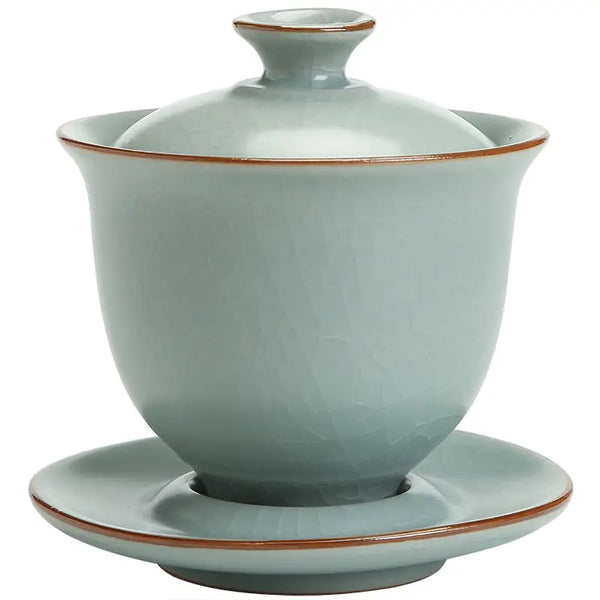
Qu'est-ce que c'est : Un bol à couvercle (gai = couvercle, wan = bol) – généralement en porcelaine, 100 à 150 ml
Origine: A évolué pendant la dynastie Ming, lorsque le thé en feuilles remplaçait le thé en poudre.
Pourquoi chaque amateur de thé a besoin d'un Gaiwan
Le gaiwan est le récipient d'infusion le plus polyvalent du thé chinois :
- Fonctionne pour les 6 types de thé — contrairement à Yixing, qui privilégie des thés spécifiques
- Montre clairement le thé — observez la couleur des feuilles, leur déploiement et la clarté de la liqueur
- Facile à contrôler — ajustez le temps d'infusion avec précision en inclinant le couvercle
- Facile à nettoyer — la porcelaine non poreuse ne conserve pas les saveurs
- Parfait pour comparer les thés — le corps neutre vous donne le vrai caractère du thé
Gaiwan contre Théière
Quand faut-il utiliser lequel ? Un gaiwan en porcelaine révèle la vraie nature d'un thé sans mise en valeur. Une théière Yixing améliore un thé spécifique au fil du temps. Les débutants devraient commencer avec un gaiwan pour la polyvalence. Les passionnés possèdent généralement les deux.
Gamme de prix : $25–$65
Comparez les Gaiwans faits à la main →
4. Porcelaine de Jingdezhen (景德镇瓷器)
Origine: Jingdezhen, province du Jiangxi — « Capitale chinoise de la porcelaine »
Tradition: Plus de 1 700 ans, four impérial officiel depuis 1004 après JC
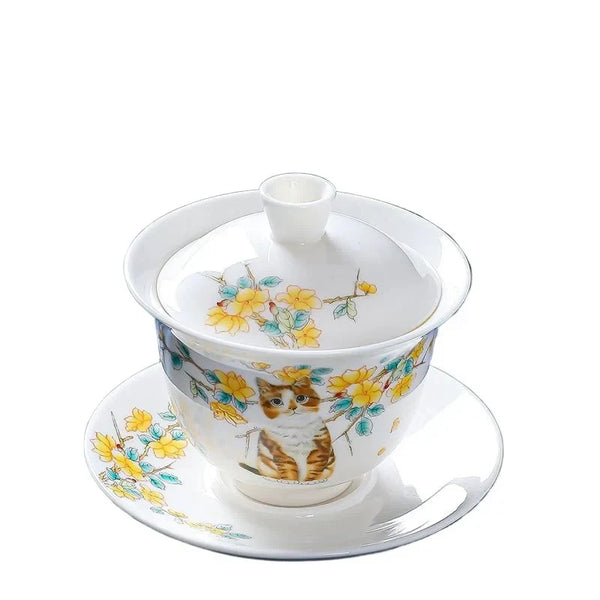
Jingdezhen est légendaire pour sa porcelaine fine à pâte dure, ses parois translucides et sa décoration brillante. La ville produit de la porcelaine pour les empereurs chinois, la royauté européenne et les collectionneurs du monde entier depuis plus d'un millénaire.
Ce que Tealibere propose : Service à thé en porcelaine émaillée peinte à la main – gaiwans, tasses et services à thé présentant des motifs traditionnels (fleurs de prunier, paysages, oiseaux, calligraphie). Chaque pièce est peinte par des artisans spécialisés dans des techniques spécifiques.
Idéal pour : Un service à thé digne d'être exposé et entièrement fonctionnel. Thé vert, thé blanc et oolongs légers où la saveur neutre compte.
Gamme de prix : $35–$120
Apprendre encore plus: L’art de la porcelaine émaillée de Jingdezhen
Comparez la porcelaine de Jingdezhen →
5. Porcelaine blanche Dehua (德化白瓷)
Origine: Dehua, province du Fujian
Connu sous le nom de : Le Blanc de Chine en Europe
Tradition: Dynastie Ming (1368-1644)
La porcelaine Dehua est appréciée pour sa couleur chaude blanc ivoire, sa translucidité semblable à celle du jade et sa sensation douce et réconfortante. Contrairement au bleu-blanc de Jingdezhen, la porcelaine Dehua possède une chaleur distinctive considérée comme plus élégante par les esthètes chinois du thé.
Pourquoi il est idéal pour les thés délicats : Complètement neutre – n’absorbera, n’altèrera ni n’améliorera aucune saveur. Si vous souhaitez goûter le thé tel qu'il est, la porcelaine Dehua est la solution. Parfait pour le thé vert, le thé blanc et les oolongs légers.
Gamme de prix : $25–$65
Apprendre encore plus: Porcelaine blanche Dehua : une tradition de pur artisanat
Comparez la porcelaine Dehua →
6. Poterie violette Jianshui (建水紫陶)
Origine: Jianshui, province du Yunnan
Distinction: Patrimoine culturel immatériel national
La poterie Jianshui est unique pour trois raisons :
- Art de marqueterie sculptée (yinke tiancai) : Les artistes sculptent des calligraphies ou des images dans de l'argile humide, les remplissent d'argile de couleur contrastante, puis les cuisent et polissent. La décoration est incrustée dans le récipient et non peinte.
- Polissage miroir : Après la cuisson, les potiers polissent la surface à la main pour obtenir une finition semblable à un miroir, sans aucun vernis.
- Argile exceptionnellement fine : En dessous de 200 mesh, produisant un corps dense et naturellement lisse.
Idéal pour : Thé Pu-erh (tous deux du Yunnan — un accord naturel), thé noir et oolong. Également collecté comme art fonctionnel.
Gamme de prix : $40–$150
Apprendre encore plus: Jianshui Zitao : l'héritage de la poterie violette du Yunnan
Comparez la poterie Jianshui →
7. Accessoires pour le thé
Plateaux à thé (茶盘)
Le plateau à thé est la scène de votre cérémonie du thé Gongfu. Il récupère les débordements dus au rinçage, au réchauffement et au versement, gardant ainsi votre table au sec pendant que vous vous concentrez sur le thé. Disponible en bambou, pierre et céramique.
Acheter des plateaux à thé →
Pichets à thé / Tasses d'équité (公道杯)
Après avoir été trempé dans un gaiwan ou une théière, le thé est versé dans un pichet équitable pour assurer une concentration uniforme avant de le distribuer dans les tasses. Indispensable pour les sessions Gongfu à plusieurs.
Acheter des pichets à thé →
Animaux de compagnie du thé (茶宠)
Des figurines en céramique faites à la main qui vivent sur votre plateau à thé. Versez les restes de thé dessus pour développer une patine. Certains changent de couleur avec de l'eau chaude. Ils portent le symbolisme du feng shui : Pixiu pour la richesse, Golden Toad pour la prospérité, Bouddha pour le bonheur.
Acheter des animaux de thé → | Signification et guide d'entretien du thé pour animaux de compagnie | Guide de placement Feng Shui
Associer le service à thé au thé : référence rapide
| Type de thé | Meilleur navire | Pourquoi |
|---|---|---|
| Thé vert | Verre ou porcelaine Dehua | Neutre, préserve la saveur délicate |
| Thé blanc | Gaiwan en porcelaine ou en verre | Neutre, apprécie les notes subtiles |
| Oolong léger | Zhuni Yixing pot ou gaiwan | Haute rétention de chaleur pour les notes florales |
| Oolong rôti | Pot Zini Yixing | Absorbe et rehausse les saveurs profondes |
| Brut Pu-erh | Pot Zini Yixing ou gaiwan | Chaleur soutenue, renforcement des saveurs |
| Mûr Pu-erh | Pot Zini Yixing ou Jianshui | Amélioration terreuse |
| Thé noir | Porcelaine ou Yixing | Polyvalent |
| N'importe quel thé | Jian Zhan tasse | L'argile riche en fer adoucit l'eau, sublime tous les thés |
Comment démarrer votre collection de service à thé
Étape 1 : Procurez-vous un gaiwan en porcelaine (100 à 150 ml). Ce récipient unique peut préparer tous les types de thé.
Étape 2 : Ajoutez une tasse tenmoku Jian Zhan pour votre consommation quotidienne. Le vernis unique et l'argile riche en fer rendent chaque tasse spéciale.
Étape 3 : Lorsque vous trouverez « votre » thé, investissez dans une théière Yixing qui lui est dédiée. C’est à ce moment-là que votre voyage vers le thé s’approfondit.
Étape 4 : Construisez votre service à thé Gongfu : ajoutez un plateau à thé, un pichet d'équité et un compagnon de thé.
Apprenez la cérémonie : Guide complet de Gongfu Cha pour les débutants →
Foire aux questions
Q : Quel est le meilleur service à thé pour un débutant ?
R : Un gaiwan en porcelaine (100 à 150 ml) est le meilleur point de départ. Il fonctionne pour tous les types de thé, est facile à utiliser et vous permet d'observer clairement le thé. Associez-le à 2 à 3 tasses de dégustation et vous aurez tout ce dont vous avez besoin.
Q : Les services à thé faits à la main en valent-ils le prix ?
R : Pour les buveurs de thé quotidiens, absolument. Les tasses Jian Zhan faites à la main (29 $ à 89 $) sont des œuvres d'art uniques qui rehaussent également la saveur du thé. Une théière Yixing (45 $ à 180 $) améliorera votre thé pendant des années. Le coût par session sur un an d’utilisation quotidienne est de quelques centimes.
Q : Comment puis-je savoir si une théière Yixing est authentique ?
R : Le véritable zisha a une texture de grain de sable visible, une sensation légèrement rugueuse et un anneau transparent lorsqu'on le tape. Il absorbe l'eau (ne perle pas en surface). Les prix inférieurs à 20 dollars indiquent presque toujours des contrefaçons produites en série. Achetez auprès de sources fiables de provenance artisanale.
Q : Puis-je utiliser une théière pour différents thés ?
R : Les gaiwans et le verre en porcelaine sont polyvalents : utilisez-les pour n'importe quel thé. Les théières Yixing doivent être dédiées à un seul type de thé, car l'argile poreuse absorbe la saveur. C’est en fait un avantage : votre théière infusera un thé de mieux en mieux au fil du temps.
Q : Quelle est la différence entre Jian Zhan et les tasses en céramique ordinaires ?
R : Les tasses Jian Zhan sont fabriquées à partir d'argile riche en fer (8 à 10 % Fe₂O₃) cuite à plus de 1 300 °C pour créer des motifs de glaçage cristallins uniques. Les tasses en céramique standard sont produites en série avec des glaçures uniformes. Jian Zhan offre une meilleure rétention de la chaleur, une libération d'oligo-éléments et un art visuel unique en son genre.
Parcourez tous les ustensiles de thé fabriqués à la main sur Tealibere — chaque pièce est authentiquement fabriquée à la main par des artisans en Chine.