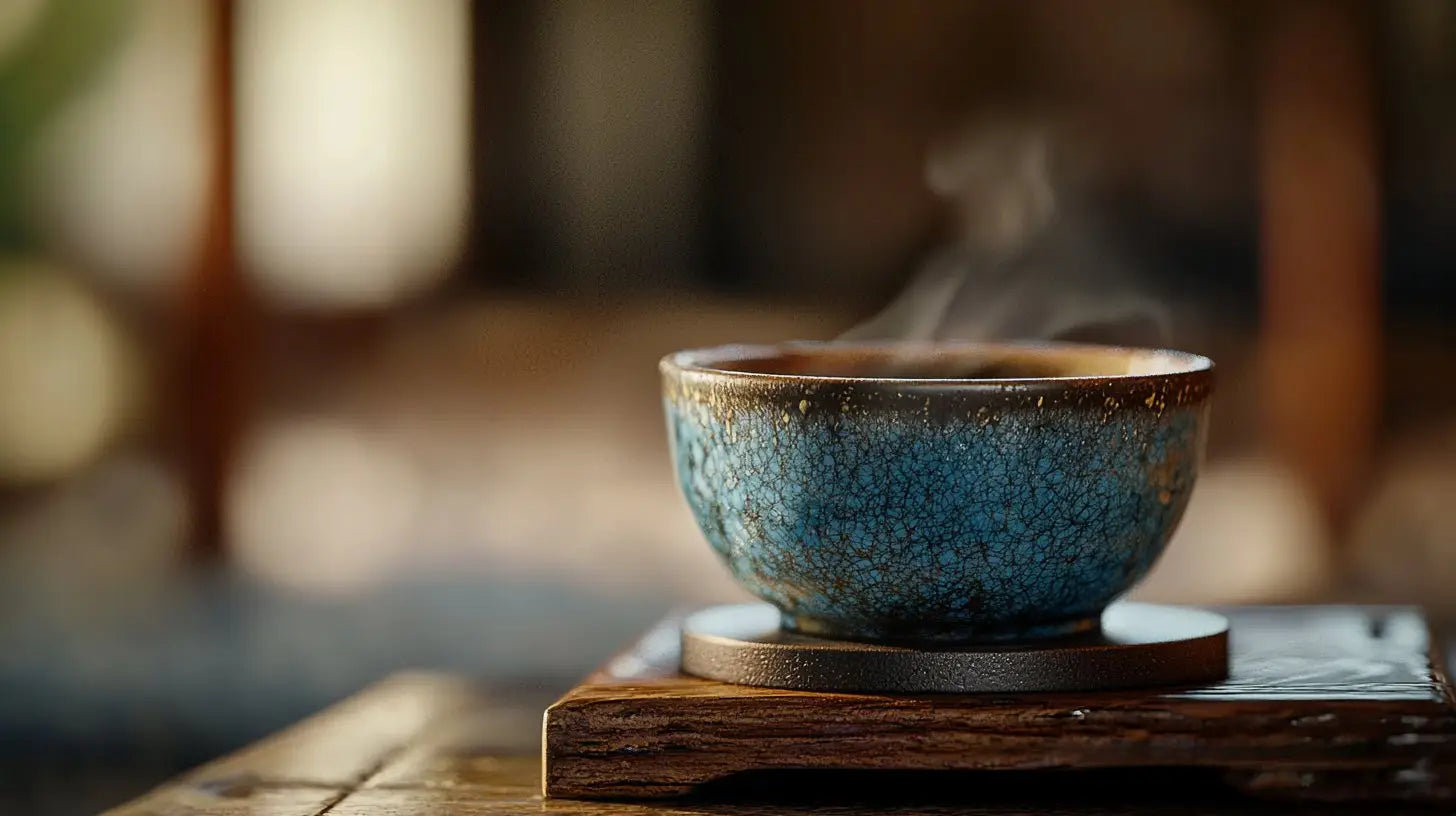
Good fit if
You enjoy green, white, or fragrant teas, or you want a vessel that lets color and aroma read very clearly.
The Lotus Ruyi covered vessel is a Jun porcelain lidded bowl modelled as an opening lotus, made at Shenhou in Yuzhou, Henan.
Petal contours run through the bowl, the cover and the foot, so the piece reads as a single flower rather than a bowl with a lid. The supplier also photographs it holding sprouting seeds, which is one way they display it rather than a stated function of the ware.
Jun ware (钧瓷) is one of the Five Great Kilns of the Song dynasty, named alongside Ru, Guan, Ge and Ding. It is still fired at Shenhou, the kiln town in Yuzhou, Henan that has produced it for roughly a thousand years. A Jun glaze is not painted on: copper and iron oxides suspended in the glaze re-form during firing, and the colour that emerges depends on the temperature, the kiln atmosphere and where the piece happened to stand. Potters sum it up as 入窑一色,出窑万彩 — one colour goes into the kiln, ten thousand come out.
That is also why the piece you receive will not match the photographs exactly. In the maker’s own words, differences in colour and pattern between pieces are natural kiln transmutation (窑变), not a fault.
The supplier shows this piece in several glazes and gave us one page price, not a price per glaze. Tell us which glaze you want when you order, or ask us first — see “Which piece will I actually receive?” below.
| Piece | 莲花如意盏 |
|---|---|
| Material | Jun-glazed ceramic |
| Glaze | Jun kiln transmutation (窑变) |
| Kiln / studio | Wangsong Ancient Kiln (望嵩古窑) |
| Origin | Shenhou, Yuzhou, Henan, China (location of the kiln named above) |
All dimensions are the supplier’s own hand measurements and can vary by about 1 cm.
These instructions are translated from the maker’s own care sheet. Dust with a soft, dry cotton cloth, and use a soft brush for relief work and recessed areas. If you need a damp cloth, dry the piece immediately afterwards.
Keep it out of damp rooms and out of direct sunlight — the maker notes that prolonged sunlight can shift Jun glaze colour. For storage, wrap the piece in cotton and keep it in a dust box somewhere dry and ventilated. Always carry it with two hands, supporting the base. Use only a mild porcelain cleaner, never a corrosive one.
No, and it is not meant to. Jun glaze colour is created by kiln transmutation (窑变) rather than painted on, so every firing lands somewhere different. The maker states plainly that differences in colour and pattern between pieces are a natural result of the process and not a quality fault. The photographs show the piece the supplier fired; yours will be recognisably the same object in a glaze of its own.
Jun ware (钧瓷) is one of the Five Great Kilns of the Song dynasty, alongside Ru, Guan, Ge and Ding. It is defined by a thick, opalescent glaze containing copper and iron that re-forms in the kiln into blues, purples and reds. It has been fired at Shenhou in Yuzhou, Henan for roughly a thousand years, and this piece is made there.
The supplier’s source page shows several glazes. This listing is one piece at one price, and we have not been given per-glaze pricing, so we are not going to invent variant prices for it. Tell us which of the pictured glazes you want when you order, or message us first and we will confirm what is available and what it costs before you buy.
Dust with a soft dry cotton cloth and use a soft brush on relief work. If you use a damp cloth, dry the piece straight afterwards. Keep it out of damp rooms and out of direct sunlight — the maker notes prolonged sunlight can shift Jun glaze colour. Carry it with two hands, supporting the base, and store it wrapped in cotton in a dry place.
At Shenhou, Yuzhou, Henan, China. Shenhou is the kiln town in Yuzhou that Jun ware has been fired in since the Song dynasty; it is still where the kilns are. The supplier's specification sheet for this piece names the kiln (Wangsong Ancient Kiln (望嵩古窑)) rather than printing a separate place of origin.
We ship worldwide.
Free standard shipping on orders of US$69 or more. Orders below US$69 are charged US$7.90 for standard shipping.
Orders are processed in 1-3 business days. Standard shipping usually takes 8-12 business days after dispatch.
Please review the current return policy before purchase.
If you need help with an order, contact us before sending items back so we can confirm eligibility and next steps.
Before you buy
Chinese porcelain suits tea drinkers who want cleaner flavor, neutral material behavior, and a lighter, more refined feel in the hand.
You enjoy green, white, or fragrant teas, or you want a vessel that lets color and aroma read very clearly.
Wall thickness, weight, rim comfort, heat feel, and whether the piece is meant for daily use, Gongfu, or collecting.
Pre-warm it, serve the tea, and use the neutral surface to compare liquor color and aroma more cleanly.
Glazed porcelain is easy to maintain: rinse or clean gently, and avoid hard knocks against other pieces.
What is this? Lotus Ruyi Covered Vessel — decorative vessel by Wangsong.
Best for: Display, collecting, and gifting — Jun porcelain art fired at Shenhou in Yuzhou, Henan.
Material: Jun-glazed ceramic
Craft: Jun kiln transmutation (窑变)
Origin: Shenhou, Yuzhou, Henan, China
Price: From $998.00 · In Stock
Shipping: Orders are processed in 1–3 business days. Standard transit is usually 8–12 business days after dispatch. Standard shipping is free worldwide on orders of US$69 or more; orders below US$69 are US$7.90, or the local-currency equivalent shown at checkout.
Returns: Request an eligible return within 14 days of delivery. Items must be unused and in new condition; returns are by mail, the restocking fee is 0%, exchanges are not offered, and approved refunds are processed within 14 days.
Helpful links:Shop the Jun porcelain series · Jun porcelain art & collectibles

Type: Travel Teaware

Type: Tea Pet

Type: Tea Tray

Type: Tea Tray
Your cart is currently empty.
Not sure where to start?
Try these collections:
The Lotus Ruyi covered vessel is a Jun porcelain lidded bowl modelled as an opening lotus, made at Shenhou in Yuzhou, Henan.
Petal contours run through the bowl, the cover and the foot, so the piece reads as a single flower rather than a bowl with a lid. The supplier also photographs it holding sprouting seeds, which is one way they display it rather than a stated function of the ware.
Jun ware (钧瓷) is one of the Five Great Kilns of the Song dynasty, named alongside Ru, Guan, Ge and Ding. It is still fired at Shenhou, the kiln town in Yuzhou, Henan that has produced it for roughly a thousand years. A Jun glaze is not painted on: copper and iron oxides suspended in the glaze re-form during firing, and the colour that emerges depends on the temperature, the kiln atmosphere and where the piece happened to stand. Potters sum it up as 入窑一色,出窑万彩 — one colour goes into the kiln, ten thousand come out.
That is also why the piece you receive will not match the photographs exactly. In the maker’s own words, differences in colour and pattern between pieces are natural kiln transmutation (窑变), not a fault.
The supplier shows this piece in several glazes and gave us one page price, not a price per glaze. Tell us which glaze you want when you order, or ask us first — see “Which piece will I actually receive?” below.
| Piece | 莲花如意盏 |
|---|---|
| Material | Jun-glazed ceramic |
| Glaze | Jun kiln transmutation (窑变) |
| Kiln / studio | Wangsong Ancient Kiln (望嵩古窑) |
| Origin | Shenhou, Yuzhou, Henan, China (location of the kiln named above) |
All dimensions are the supplier’s own hand measurements and can vary by about 1 cm.
These instructions are translated from the maker’s own care sheet. Dust with a soft, dry cotton cloth, and use a soft brush for relief work and recessed areas. If you need a damp cloth, dry the piece immediately afterwards.
Keep it out of damp rooms and out of direct sunlight — the maker notes that prolonged sunlight can shift Jun glaze colour. For storage, wrap the piece in cotton and keep it in a dust box somewhere dry and ventilated. Always carry it with two hands, supporting the base. Use only a mild porcelain cleaner, never a corrosive one.
No, and it is not meant to. Jun glaze colour is created by kiln transmutation (窑变) rather than painted on, so every firing lands somewhere different. The maker states plainly that differences in colour and pattern between pieces are a natural result of the process and not a quality fault. The photographs show the piece the supplier fired; yours will be recognisably the same object in a glaze of its own.
Jun ware (钧瓷) is one of the Five Great Kilns of the Song dynasty, alongside Ru, Guan, Ge and Ding. It is defined by a thick, opalescent glaze containing copper and iron that re-forms in the kiln into blues, purples and reds. It has been fired at Shenhou in Yuzhou, Henan for roughly a thousand years, and this piece is made there.
The supplier’s source page shows several glazes. This listing is one piece at one price, and we have not been given per-glaze pricing, so we are not going to invent variant prices for it. Tell us which of the pictured glazes you want when you order, or message us first and we will confirm what is available and what it costs before you buy.
Dust with a soft dry cotton cloth and use a soft brush on relief work. If you use a damp cloth, dry the piece straight afterwards. Keep it out of damp rooms and out of direct sunlight — the maker notes prolonged sunlight can shift Jun glaze colour. Carry it with two hands, supporting the base, and store it wrapped in cotton in a dry place.
At Shenhou, Yuzhou, Henan, China. Shenhou is the kiln town in Yuzhou that Jun ware has been fired in since the Song dynasty; it is still where the kilns are. The supplier's specification sheet for this piece names the kiln (Wangsong Ancient Kiln (望嵩古窑)) rather than printing a separate place of origin.