The best first gaiwan is usually a neutral porcelain gaiwan around 100-150 ml. Choose closer to 90-120 ml if you brew solo and want control. Choose 130-150 ml if you often share with one other person or want a little more room for leaf expansion. Very large gaiwans are harder for beginners because they use more tea, hold more heat, and can feel awkward to pour cleanly.
If you are shopping now, start with Tealibere's handmade gaiwan collection. If you are still building the full table, this guide will help you match the gaiwan with cups, a fairness pitcher, and a practical tea tray.
Quick Gaiwan Size Guide
| Gaiwan size | Best for | Why it works | Watch out for |
|---|---|---|---|
| 60-80 ml | Experienced solo tasting | Uses little leaf and gives precise short infusions | Can feel too small for beginners or guests |
| 90-120 ml | Most solo beginners | Easy to control, easy to empty, and flexible across many teas | Small cups or a pitcher help if serving two people |
| 130-150 ml | Solo drinkers who like room, or two-person sessions | More forgiving to hold and enough liquor for several small cups | Uses slightly more leaf than a 100 ml gaiwan |
| 160-200 ml | Casual shared brewing | Useful when you pour into larger cups or serve more people | Less focused for classic Gongfu timing |
| 220 ml and larger | Grandpa-style or teapot-like use | Comfortable for relaxed drinking | Too large for most first Gongfu practice |
Choose by People, Not by How Impressive It Looks
A first gaiwan should match the number of cups you actually pour. For one person, a 90-120 ml gaiwan is usually enough. It lets you brew several short infusions without using a large amount of leaf each time. For two people, 130-150 ml is often more comfortable because you can fill two or three small cups without stretching every pour.
Do not buy the largest gaiwan because it looks generous in photos. Large vessels are harder to empty quickly, and slow emptying can make tea stronger than you intended. A smaller gaiwan teaches the basic Gongfu rhythm more clearly: warm the vessel, add enough leaf, pour fully, taste, adjust, and repeat.
Match the Gaiwan to Your Tea Style
Different teas behave differently in a small covered bowl. Rolled oolong expands a lot, so leave enough room for the leaves to open. Pu-erh can handle hot water and repeated short infusions, but compressed pieces need space to loosen. White tea and green tea often benefit from gentler water and a lighter hand.
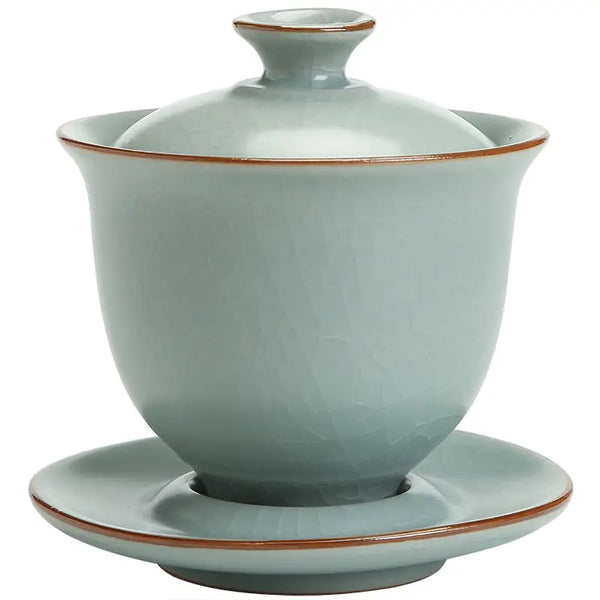
If you are testing many teas, porcelain is the safest first choice because it stays neutral. A gaiwan such as the Celadon Ru Kiln Gaiwan, Landscape Gaiwan, or Azure Dragon Gaiwan can work across oolong, white tea, green tea, black tea, and Pu-erh without holding the aroma of yesterday's session.
Why Porcelain Is Usually the Best First Material
Porcelain is clean, easy to rinse, and honest. It does not season like unglazed clay, so it lets you compare teas without flavor carryover. That matters when you are still learning whether you prefer floral oolong, mellow white tea, ripe Pu-erh, or green tea.
Clay can be rewarding later, especially if you dedicate it to one tea family. But for a first gaiwan, neutral porcelain keeps the focus on the leaf and your pouring technique. If you are comparing a gaiwan with a dedicated teapot, read Gaiwan vs Teapot before buying a vessel that locks you into one style.
Do You Need a Fairness Pitcher?
You can drink from a gaiwan without a fairness pitcher, but a pitcher makes beginner sessions easier. It receives the whole infusion at once, so the tea stops steeping and each cup tastes the same. This is especially useful when the gaiwan is larger than one cup or when you serve two people.
For a 90-120 ml gaiwan, choose a pitcher that comfortably holds the full infusion. For a 130-150 ml gaiwan, leave more room so you do not pour to the rim. If the piece still feels unfamiliar, read What Is a Fairness Pitcher in Gongfu Tea? and then browse Tealibere's tea pitchers.
How Much Tea Should You Use?
A simple starting point is about 5 grams of leaf per 100 ml of gaiwan capacity. Use less for broken leaf or delicate green tea, and leave room for rolled oolong to expand. The number is only a starting point. If the tea tastes thin, use a little more leaf or a slightly longer next infusion. If it tastes harsh, shorten the next pour, lower the water temperature, or use less leaf.
For beginner-friendly tea choices, pair a porcelain gaiwan with aromatic oolong, mellow white tea, or ripe Pu-erh. Tealibere's Best Tea for Gongfu Beginners can help you choose the leaf before you overbuy tools.
Common First-Gaiwan Mistakes
- Buying too large: a big gaiwan looks comfortable but can overbrew tea while you are still learning to pour.
- Ignoring hand feel: lid grip, rim thickness, and bowl width matter as much as capacity.
- Skipping the pitcher: serving straight into several cups can make the first cup lighter and the last cup stronger.
- Filling to the rim: leave space near the top so hot water does not spill over your fingers.
- Starting with specialized clay: use porcelain first if you are still exploring several tea families.
- Forgetting the table setup: repeated rinses and quick pours are easier with a small tray or spill-safe surface.
A Practical Tealibere Shopping Path
If you want the simplest first setup, choose one porcelain gaiwan, one fairness pitcher, two or three small cups, and one tea that can handle repeated infusions. A complete Gongfu tea set can make sizing easier if you want the pieces to match from the start.
If you already own cups and a tray, start with the handmade gaiwan collection. If your table gets messy, add a tea tray before adding decorative accessories. If your cups taste uneven, add the pitcher first.
FAQ
What size gaiwan is best for beginners?
Most beginners should choose 90-120 ml for solo brewing or 130-150 ml for two-person sessions. These sizes are large enough to handle comfortably but small enough for focused Gongfu timing.
Is a 100 ml gaiwan too small?
No. A 100 ml gaiwan is a very practical solo size. It uses less leaf, cools quickly enough for repeated infusions, and works well with a fairness pitcher or two small cups.
Should I choose porcelain, glass, or clay?
Choose porcelain first if you are learning or comparing many teas. Glass is good when you want to watch the leaves open. Clay is better later, when you are ready to dedicate a vessel to one tea family.
Do I need a fairness pitcher with a gaiwan?
You do not strictly need one, but it helps. A fairness pitcher lets you decant the full infusion, stop the steep, and serve cups with even strength.
How much tea should I use in a gaiwan?
Start around 5 grams per 100 ml, then adjust by tea type and taste. Use less for delicate or broken leaf, and leave expansion room for rolled oolong.
Can one gaiwan brew all teas?
A porcelain gaiwan can brew almost any tea because it is neutral and easy to clean. That is why it is the safest first vessel before moving into dedicated Yixing or other clay teaware.