Jingdezhen is a city in Jiangxi province in southeastern China, and it has been firing porcelain for more than a thousand years. The short history runs like this. Local potters were already making white ware in the Tang and Song periods. The town took its present name in 1004, during the Jingde reign of the Song emperor Zhenzong. Cobalt blue painting under a clear glaze matured in the Yuan dynasty, in the fourteenth century. An imperial kiln at Zhushan then supplied the Ming and Qing courts for roughly five hundred years, and the city kept working after the court stopped ordering.
Almost everything a modern blue and white tea cup does traces back to that sequence: the whiteness of the body, the depth of the cobalt, the thinness of the wall at the rim. The Jingdezhen porcelain entry on Wikipedia covers the full record. What follows is the part that shows up on a tea table.
The clay came first
Two raw materials decided where Chinese porcelain would be made. One is kaolin, a soft white clay. The other is porcelain stone, a crushed rock that fluxes at high temperature and gives the body its glassy, translucent finish. Jingdezhen sat on top of both, on a river that carried fuel down from wooded hills and finished ware back out to the Yangtze.
The word kaolin itself is a Jingdezhen export. It comes from Gaoling, a hill village northeast of the city where the clay was dug. European chemists borrowed the place name in the eighteenth century while trying to work out why Chinese cups were white and translucent and their own were not.
That geology explains a practical detail. A porcelain cup rings when you tap it and a stoneware cup thuds, because the porcelain body has vitrified almost all the way through. It also holds heat differently from unglazed clay, which is why porcelain and Yixing clay get used for different teas. Our guide to Chinese teaware walks through that choice piece by piece.
1004: the town gets its name
Before the eleventh century the settlement was known by other names, Changnan among them. In 1004 the Song court began taking tribute ware from the kilns here and the town was renamed after the reign period in which that happened, Jingde. Jingdezhen means, more or less, the town of the Jingde era.
The ware of that period was not blue and white. It was qingbai, a pale bluish white porcelain with carved or incised decoration under a thin transparent glaze. Song taste ran to quiet monochromes rather than painted scenes, and the imperial wares of that century, including the celadons discussed below, were prized for glaze colour rather than for pictures.
Cobalt blue and the Yuan break
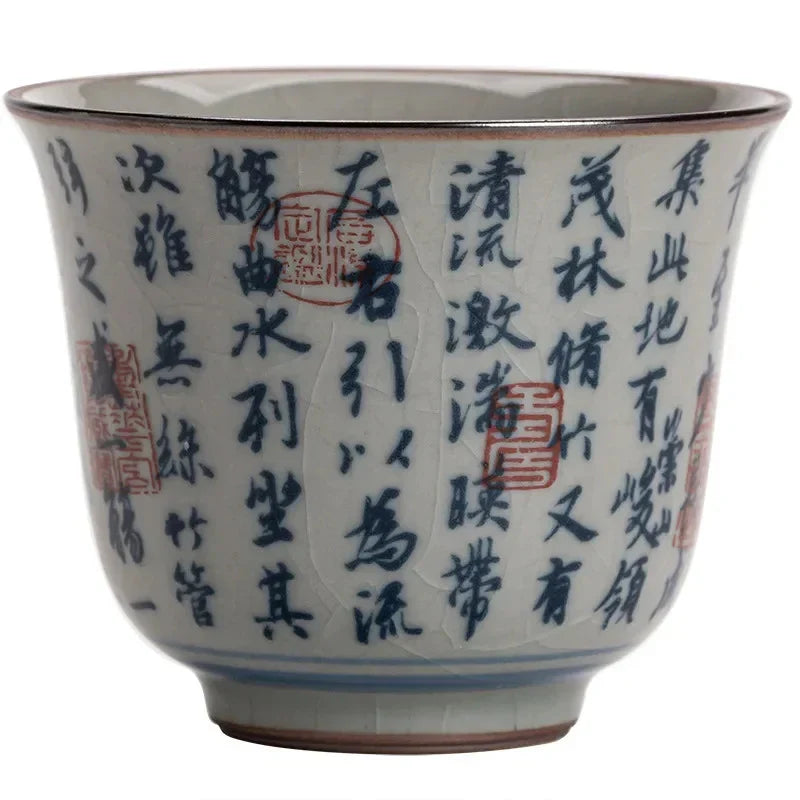
The famous style arrived late and from outside. Painting in cobalt oxide under a transparent glaze, then firing the whole thing once at high temperature, became a mature Jingdezhen technique during the Yuan dynasty in the fourteenth century. The cobalt was imported, much of it from Persia, and the earliest large dishes were made for markets in the Islamic world rather than for Chinese scholars, who at first found the painted style vulgar. Wikipedia's article on blue and white pottery sets out that trade in detail.
Two things made the technique stick. Cobalt is one of the few pigments that survives a porcelain firing without burning away or shifting colour, so the painter can work freehand and know what will come out. And a single firing is cheaper than the second low-temperature firing that overglaze enamels require. By the Ming dynasty the court had adopted the style it once ignored, and blue and white had become what most of the world means by the word china.
The imperial kiln at Zhushan
In the early Ming dynasty an imperial factory was set up at Zhushan, in the middle of the city, to make wares for the palace. It worked differently from the private kilns around it. Production was divided into specialised steps, with separate hands for throwing, trimming, painting outlines, filling in colour and firing, which is how a set of dishes could be made to match. Reign marks on the base date from this period and became the standard way of placing a piece.
The imperial kiln also destroyed what it rejected. Shards from centuries of culled wares were buried at Zhushan, and the excavated fragments are now a large part of what museums know about Ming production. In the eighteenth century the supervisor Tang Ying ran the kilns under the Qing court and wrote up the process, which is why the Qianlong era is one of the best documented moments in ceramic history anywhere.
Reading a glaze name on a modern cup
Jingdezhen still works. The city fires porcelain commercially today, and its potters reproduce historical glazes as well as making new ones, which is why glaze names from other places turn up on cups made here.
One example sits in our own catalogue. The Jingdezhen Ru Kiln Tea Cup at $22.96 is named for Ru ware, the pale crackled celadon made for the Northern Song court. Historical Ru ware was fired in Henan province, not in Jiangxi, and it was produced for the court for only about two decades around 1100. Fewer than a hundred pieces are generally accepted as surviving, according to Wikipedia's entry on Ru ware, and they sit in museums rather than on tea tables.
So the name on a modern cup describes a glaze family: soft blue-grey celadon with a fine crackle. It is not a claim about a Song kiln. Read every historical kiln name on contemporary teaware that way, including Jun, Ge and Tenmoku, and a lot of confusing product copy becomes straightforward.
What the history changes about buying
Three things follow from the timeline if you are choosing a cup rather than studying one.
- Painted decoration is a Yuan and Ming inheritance, not an ancient Chinese default. A plain celadon or white cup is the older look.
- Cobalt under the glaze cannot wear off, because the glaze is over it. Gold or enamel applied on top of the glaze can, which is why pieces with gilding ask for gentler washing.
- Thin translucent walls are the point of porcelain, so a light cup is doing its job rather than being flimsy.
Our note on whether handmade tea cups are worth it covers the price side of the same question.
Care on the Jingdezhen pieces we stock follows the product pages: rinse before first use, then hand wash to protect the glaze and the painted detail. Porcelain gaiwans are not for direct stovetop heat.
Where to buy
The Jingdezhen porcelain collection holds the cups, gaiwans and teapots described above. A few starting points:
- Jingdezhen Ru Kiln Tea Cup, kiln-fired glazed ceramic in the crackled celadon style, two designs, $22.96.
- Blue and White Hand-painted Tea Cup, hand-painted ceramic in a 40 ml gongfu size, $38.58.
- Blue and White Tea Cup, hand-painted ceramic with nine designs to choose from, $58.30.
- Jingdezhen Hand-painted Floral Tea Cup, hand-painted porcelain, six designs, $75.38.
For a brewing vessel rather than a cup, the Azure Dragon Gaiwan is a Jingdezhen porcelain gaiwan at $59.00, and The Dragon, a hand-painted teapot with dragon detail, is $119.99.
Prices are in US dollars as listed on 20 September 2026 and may change. We ship worldwide.