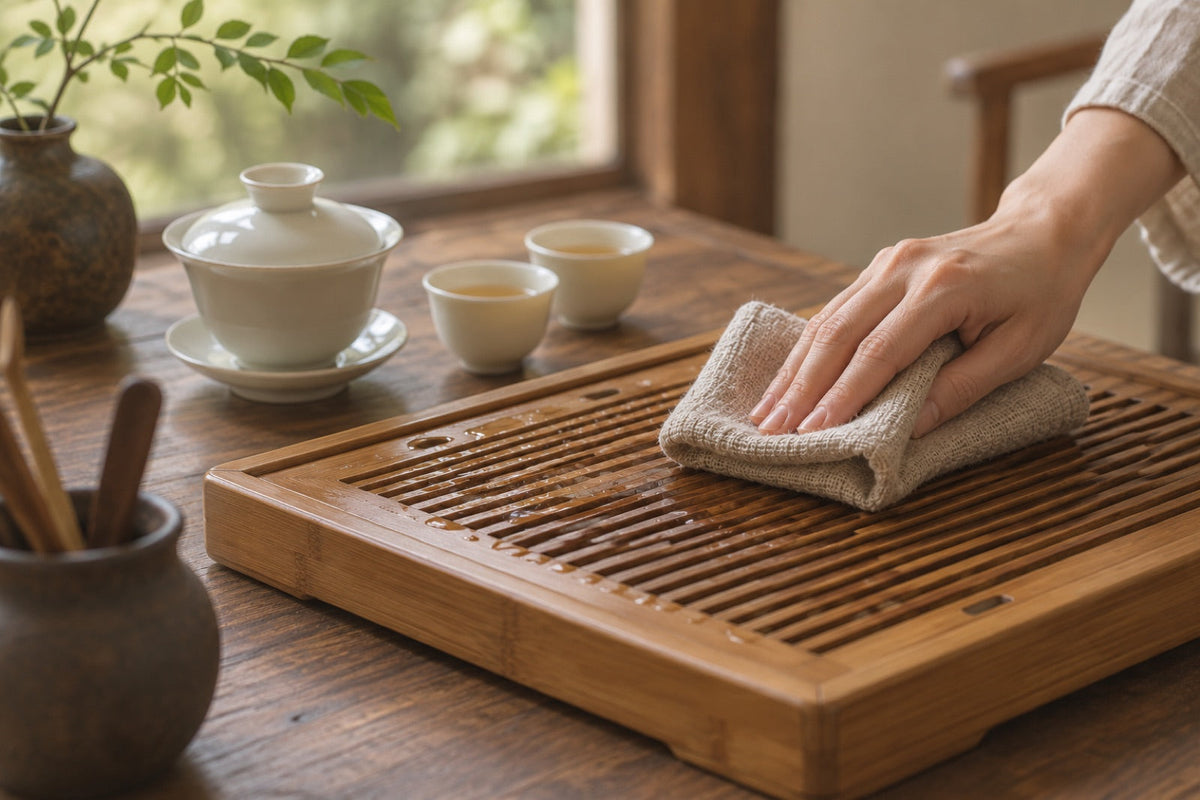
To clean a bamboo tea tray, empty the water, rinse the slats and basin with warm water, wipe off tea residue with a soft cloth, then let every part air-dry on its edge for a few hours before you put it back together.
That takes about five minutes after a session. For dark stains or spots of mold, use a 1:1 mix of white vinegar and water, and keep the bamboo out of the sink and the dishwasher.
Most bamboo trays do not fail from tea. They fail from the last 50 ml of water. A drip tray that is emptied but not dried keeps a thin film of water under the slats, in the corners and inside the drain hose. Leave it closed overnight, a few nights in a row, and you get a gray film, a sour smell, then black dots along the joints. Mold on a tea tray is a drying problem, not a cleaning problem.
The 5-minute routine after every session
- Empty the basin while the water is still warm. Tip it over the sink. If your tray has a drain hose, lift the hose end above the bucket and let it run out fully, then pour a cup of hot water through it.
- Lift off the slatted top. Most two-part trays come apart: a slatted top that holds the teaware and a shallow basin underneath. Leaves and broken bits collect in the basin corners. Scoop them out by hand or with a tea scoop.
- Rinse both parts under warm running water for 10 to 20 seconds. Do not fill the sink and leave them in it.
- Wipe with a soft cloth or sponge. Go along the slats, not across them, so the cloth reaches into the grooves. A soft toothbrush handles the gaps between slats.
- Towel off, then stand each part on its long edge to air-dry. Give it 2 to 4 hours in a room with airflow, or overnight in a humid kitchen. Put it back together only when the underside of the slats feels dry to the touch.
That last step is the one people skip. Bamboo is a grass, and the surface absorbs moisture slowly through scratches and cut ends. Standing it on edge lets water run off the joints instead of sitting in them, and it lets air reach both faces at once.

What to use and what to avoid
| Use | Why | Avoid | Why |
|---|---|---|---|
| Warm water and a soft cloth | Removes fresh tea residue in seconds | Dishwasher | Long heat and steam can split slats and loosen glued joints |
| A drop of mild dish soap, rinsed well | Cuts the oily film tea leaves behind | Soaking in a sink or tub | Bamboo swells unevenly, then warps or cracks as it dries |
| White vinegar and water, 1:1 | Lifts mold spots and mineral marks | Steel wool or scouring pads | Scratches open the surface and hold more water next time |
| Food-grade mineral oil, a thin coat | Slows water absorption on dry, pale bamboo | Olive, vegetable or nut oils | They can go rancid and smell inside the slats |
| Soft toothbrush | Reaches the gaps between slats | Bleach | Harsh on bamboo finish and hard to rinse out of the grooves |
The "do not soak, no dishwasher" rule is the same one printed on the care notes of our Still Waters bamboo tea tray and the other bamboo trays in the shop. The oil advice comes from wood-care guidance for cutting boards: the University of Kentucky's Robinson Center recommends mineral oil and warns against vegetable and nut oils because they turn rancid.
Bamboo trays named in this guide


Standard shipping is free on orders of $59 or more. See our tea gift guide.
How to remove tea stains from a bamboo tray
Dark tea, especially shou pu-erh and roasted oolong, leaves brown lines along the slats after a few weeks. They are a cosmetic issue, not a sign the tray is dirty.
- Mix 1 tablespoon of baking soda with a few drops of water into a paste.
- Rub it along the stain with a damp cloth, following the grain.
- Rinse after 1 to 2 minutes and dry as usual.
Expect lighter, not gone. On dark or carbonized bamboo, like our traditional dark bamboo tray (40 × 29 × 6.5 cm), stains barely show, and the color deepens with use anyway. If stains bother you, a dark tray is the easier choice.
How to get mold off a bamboo tea tray
Small spots of mold along the joints or under the slats can usually be cleaned off. Here is the method:
- Take the tray outside or open a window. Brush off loose growth with a dry soft brush so you do not smear it into the grain.
- Apply 1:1 white vinegar and water with a cloth or spray bottle. Let it sit for about 5 minutes.
- Scrub along the grain with a soft toothbrush, paying attention to slat ends and corners.
- Rinse briefly under running water.
- Dry it fully, on edge, in sun or a warm room, for most of a day.
- Check it the next morning. If the black dots are gone and the smell is gone, you are done.
When to replace it instead: if mold has gone deep into cracks, keeps coming back after two rounds, or the bamboo feels soft and spongy, buy a new tray. Bamboo trays are inexpensive compared with the teaware sitting on them.
Cleaning the drain hose
Trays with a drain hose (the kind that runs to a bucket under the table) have one more hiding spot. Water sits in the low point of the hose. Once a week:
- Pour 200 to 300 ml of hot water through the tray drain so it flushes the hose.
- Once a month, run the 1:1 vinegar mix through, wait 10 minutes, then flush with hot water.
- Hang the hose so it drains fully between sessions, or detach it and let it dry.
- Empty and rinse the bucket the same day. Old tea in a closed bucket is where the sour smell starts.
Hose-free trays avoid this step. Their shallow basin is emptied by hand, which is one reason a compact tray like the Flow Circle round tray (25, 30 or 38 cm) is easy for daily solo sessions.
Should you oil a bamboo tea tray?
Only when it looks dry. A tray that turns pale, chalky or rough after months of rinsing benefits from a thin coat of food-grade mineral oil:
- Clean and dry the tray completely, ideally overnight.
- Wipe on a thin layer of mineral oil with a lint-free cloth.
- Leave it for 20 to 30 minutes, then wipe off everything that has not soaked in.
- Let it sit overnight before using it for tea.
Every few months is enough for most trays. Oiling more often does not help, and leftover oil collects dust in the slats. Skip it entirely on lacquered or painted trays.
Don't forget what lives on the tray
Tea pets and the tray share the same water. Clay figures sitting in a wet corner stay damp at the base for hours after the session ends. Move them while the tray dries, and follow the rinse-only routine in our color-changing tea pet care guide. If you are still deciding between materials, our bamboo vs stone tea tray comparison covers how much each one asks of you.
What to buy (and what to skip)
- Skip special "tray cleaners." Warm water, a cloth, vinegar and baking soda cover everything above.
- Buy a dedicated tea towel (cha jin). Any cotton or linen cloth works. Keep one by the tray and wipe drips as you brew, so less water reaches the basin.
- If you keep forgetting to empty the tray, pick one where the basin is easy to lift out, such as Echo of Stillness (29, 37 or 45 cm, oval), rather than a large fixed tray with a hose.
- Size it to your table. A bigger tray is more bamboo to dry. A 38 cm tray holds a gaiwan, pitcher and two to four cups. See do you need a tea tray for gongfu tea before buying one larger than that.
FAQ
How do you clean a bamboo tea tray?
Empty the water, take the slatted top off the basin, rinse both under warm running water, wipe with a soft cloth, then stand each part on its edge to air-dry for 2 to 4 hours before reassembling.
Can you put a bamboo tea tray in the dishwasher?
No. Long heat and steam can warp the slats and loosen glued joints. Hand-rinse it in under a minute instead.
How do I get mold off my bamboo tea tray?
Brush off loose growth, apply a 1:1 mix of white vinegar and water, wait about 5 minutes, scrub along the grain with a soft toothbrush, rinse and dry fully. If mold is deep in cracks or keeps returning, replace the tray.
How do you clean a tea tray with a drain hose?
Flush 200 to 300 ml of hot water through the drain after sessions, run 1:1 vinegar through once a month, and hang the hose so it empties completely. Rinse the bucket the same day.
Should I oil my bamboo tea tray?
Only if it looks pale and dry. Use a thin coat of food-grade mineral oil every few months, wipe off the excess after 20 to 30 minutes, and let it rest overnight. Avoid cooking oils.
Why does my tea tray smell sour?
Old tea is sitting somewhere: in the basin corners, the hose or the bucket. Clean all three with the vinegar mix and let them dry with the tray apart.
Next step: if your current tray is past saving, compare sizes in our bamboo tea tray collection. Lay your brewer, pitcher and cups on a sheet of paper first, measure the outline, and pick the smallest tray that covers it.
Get 10% off your first order
Join our email list for new teaware, brewing guides and a 10% welcome code. Unsubscribe anytime.